
A recognized brand and operating system can reduce some startup uncertainty, but the franchise agreement limits how you operate, sell, renew, and exit. Before you purchase a franchise, compare the Franchise Disclosure Document, or FDD, with the actual agreement, financial model, territory, required purchases, and conversations with current and former franchisees. Federal rules require the FDD at least 14 calendar days before you sign a binding agreement or pay the franchisor or an affiliate.
Key Takeaways
- The FTC Franchise Rule requires a current FDD at least 14 calendar days before signing a binding agreement or paying the franchisor or an affiliate.
- The FDD contains 23 disclosure items, but it does not mean the government verified the franchise or guarantees results.
- Review Item 7 estimated initial investment together with working capital, debt service, local buildout, and personal living needs.
- Treat financial performance claims outside Item 19 cautiously and reconcile every model with the disclosed assumptions.
- Compare territory language, online sales, reserved channels, relocation rights, renewal, transfer, default, and personal guaranty terms.
- Speak with current and former franchisees listed in Item 20 and document questions before the review period expires.
Table of Contents
- What Is the FDD?
- How Does the 14-Day Rule Work?
- Which FDD Items Deserve the Closest Review?
- How Should You Review Financial Performance Claims?
- What Territory and Competition Terms Matter?
- Which Franchise Agreement Clauses Create Long-Term Risk?
- What Should You Ask Current and Former Franchisees?
- How Do You Compare the FDD With the Agreement?
- What Should Happen Before You Sign?
- FAQs
What Is the FDD?

The FDD is a presale disclosure document organized into 23 required items. It covers the franchisor, litigation, bankruptcy, fees, initial investment, supplier restrictions, franchisee obligations, financing, support, territory, trademarks, patents and copyrights, owner participation, product restrictions, renewal and transfer, public figures, financial performance representations, outlet information, financial statements, contracts, and receipts.
The FTC Franchise Rule gives prospective franchisees material information to assess risk. Disclosure is not approval. The FTC’s consumer guide to buying a franchise states that the document should be read carefully and used for investigation.
How Does the 14-Day Rule Work?
The franchisor must provide the current FDD at least 14 calendar days before the prospect signs a binding agreement or pays the franchisor or an affiliate. The legal rule appears in 16 C.F.R. § 436.2.
If the franchisor unilaterally and materially changes the attached agreement, it generally must provide the revised agreement at least seven calendar days before signing. Changes initiated through the prospect’s negotiation are treated differently under the rule.
Use the period to review documents, speak with franchisees, test financing, investigate the location, and obtain legal and accounting advice. Do not let a sales deadline replace diligence.
Which FDD Items Deserve the Closest Review?

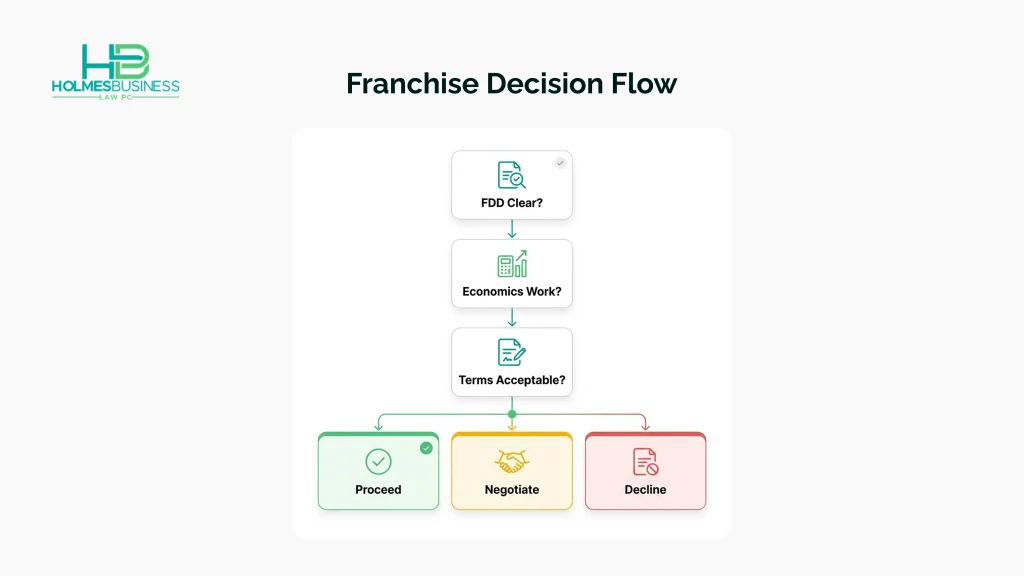
Read all 23 items, then connect the most decision-sensitive items to the attached agreements.
| FDD Area | What to Test |
| Items 3 and 4 | Litigation, government actions, bankruptcy, and management history |
| Items 5 to 7 | Initial fees, recurring fees, and total opening capital |
| Item 8 | Required suppliers, rebates, purchasing restrictions, and margins |
| Items 11 and 12 | Support, advertising, systems, territory, and reserved channels |
| Items 17 and 18 | Renewal, termination, transfer, disputes, and public figures |
| Item 19 | Basis, scope, assumptions, and limits of financial claims |
| Item 20 | Openings, closures, transfers, and franchisee contacts |
| Item 21 | Audited financial statements and franchisor financial condition |
Calculate which expenses are fixed, percentage-based, discretionary, or subject to change. Fees can include royalties, advertising, technology, training, renewal, transfer, audit, late payment, required upgrades, and liquidated damages.
How Should You Review Financial Performance Claims?
A financial performance representation should be located in Item 19 and evaluated against its assumptions and population. Ask whether the numbers reflect average, median, top quartile, mature units, company-owned units, franchised units, gross sales, or profit.
Test:
- Number and percentage of outlets included.
- Time in operation.
- Geography and market size.
- Gross revenue versus net profit.
- Labor, rent, royalties, advertising, technology, debt, and owner compensation.
- Closures and underperforming units excluded from the data.
- Whether substantiation is available as the FDD states.
Build your own model with local rent, wages, financing, buildout, and working capital. Do not treat a salesperson’s oral projection as guaranteed performance.
What Territory and Competition Terms Matter?
A territory is valuable only to the extent the agreement restricts competing channels. Review the territory map, exclusivity, performance conditions, relocation, reservation of rights, online sales, delivery, national accounts, alternative channels, company-owned units, and other brands.
Ask whether the franchisor can sell directly into the area, approve another unit nearby, change boundaries, or condition exclusivity on sales quotas. Compare Item 12 with the agreement and any site addendum.
Location approval does not guarantee sales. If the site is leased, coordinate lease terms with the franchise term, renewal rights, personal guaranty, assignment, and franchisor step-in rights. The commercial lease review service can be considered alongside the franchise agreement.
Which Franchise Agreement Clauses Create Long-Term Risk?
The agreement controls the relationship after signing. Review:
- Term and renewal conditions.
- Required remodeling, equipment, and technology.
- Operating standards and manual changes.
- Pricing restrictions and promotions.
- Approved suppliers and rebates.
- Advertising fund and local spend.
- Audit rights and record access.
- Default, cure periods, termination, and post-termination duties.
- Transfer approval, fees, buyer qualifications, and right of first refusal.
- Noncompetition, nonsolicitation, and confidentiality.
- Personal guaranty and spouse signature.
- Indemnity, insurance, dispute forum, arbitration, jury waiver, and attorneys’ fees.
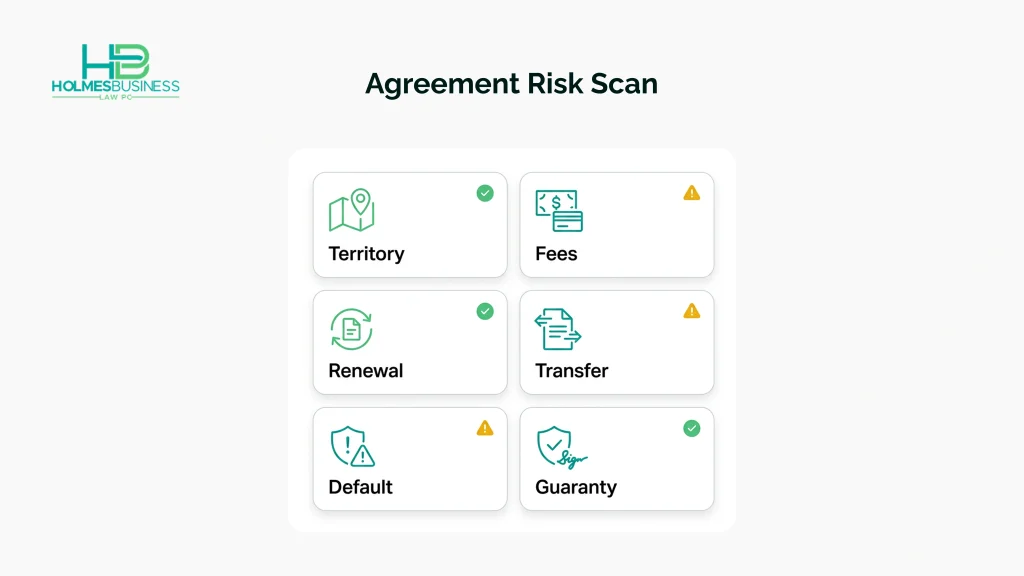
Renewal may require signing the franchisor’s then-current agreement, which can change fees and rights. Transfer restrictions affect exit value. A broad personal guaranty can expose the owner beyond the investment entity.
Use Holmes Law’s business contract review to compare the FDD disclosures, franchise agreement, guaranty, and lease before the deadline.
What Should You Ask Current and Former Franchisees?
Franchisee calls test how disclosed systems work in practice. Use Item 20 contacts and ask consistent questions:
- How long did opening take and what caused delays?
- Was total investment within Item 7 estimates?
- How much working capital was needed?
- What support was useful before and after opening?
- How do supplier pricing and product margins compare with expectations?
- What are the largest recurring fees?
- How does the franchisor respond to operational problems?
- Were territory or online-channel conflicts material?
- What upgrades were required?
- Why did former franchisees leave or transfer?
Do not ask for confidential information or assume one person’s experience predicts yours. Look for patterns across markets and time periods.
How Do You Compare the FDD With the Agreement?
Create an issue list that links each disclosure to the clause that makes it binding. A promise in a sales presentation may not appear in the agreement. The agreement may also contain an integration clause stating that the signed contract replaces prior statements.
Compare fees, territory, training, support, technology, opening deadlines, transfer, renewal, default, guaranties, dispute terms, and required purchases. Record each inconsistency and request written clarification or amendment.
The mergers and acquisitions practice can help when the transaction involves buying an existing franchised unit rather than opening a new location. That deal adds seller diligence, purchase documents, lease assignment, franchisor transfer approval, and historical liabilities.
What Should Happen Before You Sign?
Complete the commercial, legal, financial, and location review before signing or paying. Confirm:
- The FDD receipt date and version.
- The complete agreement package and guaranties.
- A realistic Item 7 and working-capital model.
- Franchisee and former-franchisee calls.
- Territory and site analysis.
- Financing conditions.
- Lease terms aligned with the franchise.
- Required entity formation, licenses, and insurance.
- Negotiated changes in writing.
- A clear understanding of renewal, transfer, default, and exit.
If the franchisor will not change standard terms, legal review still identifies the risk you are choosing to accept.
FAQs
An FDD is the federally required disclosure document containing 23 items about the franchisor, fees, obligations, system, financial information, and agreements.
You must receive it at least 14 calendar days before signing a binding agreement or paying the franchisor or an affiliate.
No. The Franchise Rule requires disclosure, but the government does not guarantee the investment or verify that it will succeed.
Item 19 contains any financial performance representations the franchisor chooses to make under the rule.
Item 20 provides outlet information and contact details that can support conversations with current and former franchisees.
Some franchisors negotiate certain terms and others do not, but requested changes should be documented in the signed agreement package.
Red flags include pressure to pay early, oral earnings claims outside the FDD, unexplained closures, weak financial statements, broad territory reservations, and harsh default or guaranty terms.
Legal review can identify binding fees, territory limits, transfer restrictions, personal exposure, default rights, and inconsistencies before signing.
Yes. It adds seller, financial, liability, lease, asset, and transfer diligence to the franchisor’s approval process.
Conclusion
Start with the FDD receipt date, then build one issue list across the disclosures, agreement, financial model, franchisee calls, financing, and lease. Decide whether the likely unit economics justify the fees and restrictions and whether the exit terms preserve value. If you have an FDD and agreement package, have the binding terms and guaranty reviewed before the 14-day period expires or any payment becomes due.