

You can negotiate the perfect purchase price, get the lender lined up, and feel ready to close, only for the deal to hit a wall over one document: landlord consent.
If the business operates out of leased space, the lease is often as valuable as the equipment, inventory, and brand. A smooth lease assignment keeps the doors open. A messy one can delay closing, force renegotiation, or kill the deal entirely.
This guide explains how lease assignment works when buying a business in Philadelphia, what landlord consent really means, what landlords typically ask for, and how to protect your timeline.
Table Of Contents
- Why Lease Assignment Can Make Or Break A Philadelphia Business Purchase
- Lease Assignment Vs Sublease Vs New Lease
- Where Landlord Consent Shows Up In The Purchase Deal
- What To Look For In The Lease Assignment Clause
- What Landlords Usually Require Before They Say Yes
- Step-By-Step: How To Get Landlord Consent Without Derailing Closing
- Philadelphia Location Due Diligence You Should Not Skip
- Common Problems And How To Handle Them
- When A New Lease Is A Better Play Than An Assignment
- FAQs
- Conclusion And Key Takeaway

Why Lease Assignment Can Make Or Break A Philadelphia Business Purchase
When you buy a business that has a physical location, you are usually buying more than a company. You are buying its ability to operate at that address.
If you cannot legally step into the lease, you may end up with:
- A business you own but cannot run from the current location
- A forced move that loses walk-in traffic and breaks customer habits
- A landlord who uses your closing deadline to demand a rent increase or a new guaranty
- A delayed closing that burns cash, patience, and sometimes financing
A lease assignment is the legal mechanism that transfers the tenant’s rights and obligations to you, the buyer, usually with the landlord’s written consent.
Lease Assignment Vs Sublease Vs New Lease

Lease Assignment
A lease assignment typically transfers the tenant’s entire interest in the property for the remainder of the term. After assignment, the buyer becomes the tenant under the existing lease, subject to the terms and any consent conditions the landlord adds.
Sublease
A sublease usually means the original tenant remains the tenant on the master lease, and the buyer becomes a subtenant. This can be useful if the landlord refuses an assignment or if the seller is staying involved for a transition period, but it can also add risk because you are one layer removed from the landlord.
New Lease
Instead of assigning the existing lease, the landlord may require or prefer that you sign a brand-new lease directly with them. This can be good if the current lease is terrible or if you need longer-term security, but it can also mean higher rent, new build-out rules, and tougher default terms.
Where Landlord Consent Shows Up In The Purchase Deal
Landlord consent is not just a lease issue. It is a deal-structure issue.
In many business purchase agreements, the lease assignment and landlord consent become:
- A condition to closing, meaning the buyer is not required to close unless consent is obtained
- A timeline driver, because landlords rarely move on the same schedule as buyers and sellers
- A leverage point, because the landlord knows the buyer wants the location and the seller wants to close
If you are buying a business in Philadelphia and the location matters, you want the purchase agreement to treat the lease transfer as a core closing deliverable rather than an afterthought.
If you want legal support on the transaction side, see our Business Purchase Or Sale Services.
What To Look For In The Lease Assignment Clause
Before you assume anything, get the lease and read the “assignment and subletting” section carefully. The right answer is almost always, it depends on the lease language.
Consent Standard
Common consent standards include:
- Consent is in the landlord’s sole discretion
- Consent not to be unreasonably withheld, conditioned, or delayed
- Consent required, but the lease lists specific objective denial reasons
This wording matters because it affects your negotiating leverage if the landlord drags their feet or says no.
Transfers That Count, Including Change Of Control
Some leases define “transfer” broadly and treat these as consent-triggering events:
- Assignment of the lease
- Sale of substantially all business assets
- Transfer of a controlling interest in the tenant entity
- Merger or restructuring
This is the classic surprise in stock sales or LLC membership interest transfers. The tenant name stays the same, but the ownership changes, and the lease may still require landlord consent.
Fees, Legal Costs, And Timing
Many leases require the tenant to:
- Pay the landlord’s review fees and legal fees
- Use the landlord’s consent form
- Provide notice and wait for written consent
- Close only after all documents are signed
If you are on a tight closing schedule, the fee and timing provisions can become the hidden delay.
Use Clauses, Exclusives, And Alterations
Landlords focus on how the space will be used. Watch for:
- Narrow permitted-use clauses that do not match how you plan to operate
- Exclusivity clauses in shopping centers that restrict certain uses
- Buildout and alteration requirements that can slow opening after closing
Guaranty And Security Deposit Requirements
A landlord may approve the assignment but require:
- A personal guaranty from the buyer
- A replacement guarantor if the seller guaranteed the lease
- An increased security deposit
- Updated insurance certificates
Even if you love the business, you should understand what you are personally putting on the line.
For help reviewing and negotiating lease terms, visit our Commercial Lease Services.
What Landlords Usually Require Before They Say Yes
Most landlords are not trying to ruin your deal. They are trying to reduce their risk.
Common landlord requests include:
- A written consent request and a copy of the purchase agreement section addressing lease transfer
- Buyer financials, sometimes including personal financial statements
- Business plan or operating summary, especially if the use will change
- Proof of experience operating a similar business
- Draft assignment and assumption agreement
- Updated insurance certificates
- Confirmation that the current tenant is not in default, or a plan to cure defaults before closing
- Application fees and landlord legal fees
This is why you want to start the consent process early, not the week before closing.
Step-By-Step: How To Get Landlord Consent Without Derailing Closing
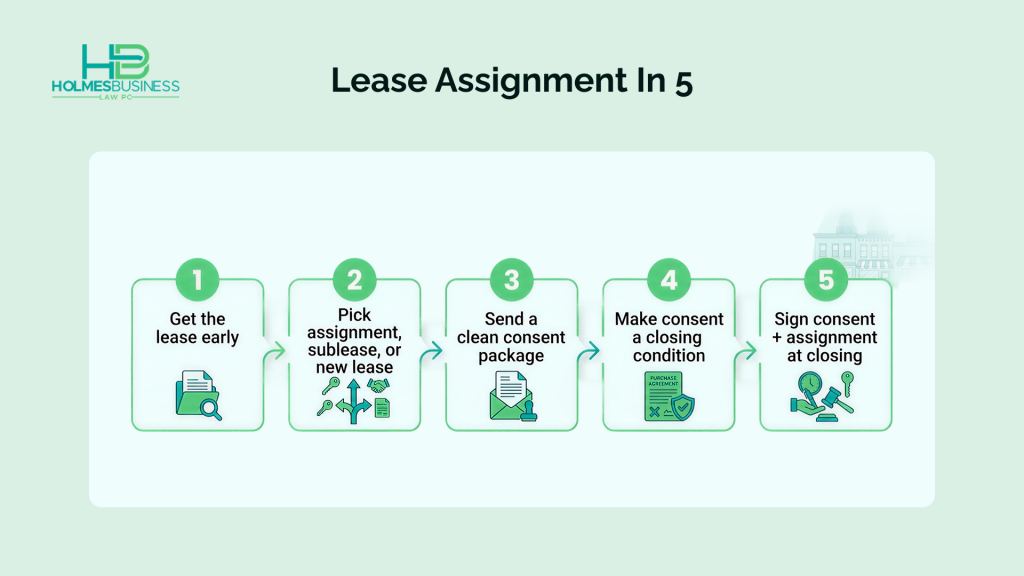
Step 1: Get The Lease Early, Not After You Sign The Purchase Agreement
If you are serious about buying the business, request the lease during early diligence. You are looking for assignment restrictions, default language, use limitations, and personal guaranty exposure.
Step 2: Decide The Right Path: Assignment, Sublease, Or New Lease
Match the path to your goals:
- Want speed and continuity, and the lease is solid: assignment
- Need a transition period, or landlord will not release seller: sublease might be a temporary bridge
- Lease is bad, term is short, or you want long-term control: negotiate a new lease
Step 3: Build A Clean Consent Package
Make it easy for the landlord to approve you. Provide a neat package with:
- Buyer entity details
- Financials
- Business overview
- Draft assignment and assumption
- Proposed closing date and requested response timeline
A sloppy package creates delays, even when the landlord is inclined to say yes.
Step 4: Put Guardrails In The Purchase Agreement
Protect yourself with deal terms like:
- Landlord consent is a condition to closing
- Seller must cooperate and provide documents quickly
- Seller must cure any lease defaults, or credits are applied at closing
- Clear allocation of who pays landlord fees and legal costs
- A realistic outside closing date that accounts for landlord turnaround
Step 5: Make Sure The Paper Trail Matches Reality
At closing, you typically want:
- Landlord’s written consent
- Assignment and assumption signed by buyer and seller
- Any new guarantee documentsare clearly defined
- Confirmations on security deposit transfer or replacement
- Written confirmation of current rent, arrears, and any CAM reconciliations
This is where experienced counsel can prevent the “we thought it was handled” problem.
If you want help coordinating the business purchase and lease transfer together, start with our Business Purchase Or Sale Services.
Why Choose Holmes Business Law For Your Lease Assignment And Purchase
Buying a business in Philadelphia is already a high-stakes transaction. When the deal also depends on a commercial lease assignment, you want counsel who can connect the dots between the purchase agreement, the lease, and the landlord consent process.
Here is what Holmes Business Law helps clients do in lease-driven business purchases:
- Spot lease problems early, before they turn into closing delays, including consent standards, transfer definitions, hidden fees, and use restrictions.
- Align the purchase agreement with the lease process so landlord consent is treated as a true closing deliverable, with clear deadlines, cooperation requirements, and risk allocation.
- Prepare a clean consent package, including draft assignment and assumption documents, so landlords have everything they need to respond more quickly.
- Negotiate practical outcomes, like a defined consent timeline, a fair guaranty scope, or a lease extension when the remaining term does not support the purchase price.
- Reduce surprises after closing by confirming key lease terms in writing, including rent, arrears, security deposit handling, and CAM status.
If you are buying, selling, or restructuring a small business and the lease matters, you can explore services here:
Business Purchase Or Sale Services
Commercial Lease Services
Philadelphia Location Due Diligence You Should Not Skip
Buying a business in Philadelphia also means ensuring the location can legally support the operation.
Even if the lease transfers cleanly, you can still get stuck if the use is not permitted, or if there are open violations tied to the property or prior buildout.
Two helpful local resources to review during diligence are:
- The City’s Commercial Leasing Notice, which walks tenants through researching zoning, permits, and open violations before signing a lease
Commercial Leasing Notice PDF - The Philadelphia VIP Commercial Leasing Guide for small businesses and nonprofits, which explains common commercial lease terms, including assignments
Philadelphia VIP Commercial Leasing Guide
If the business depends on a specific use approval, confirm early whether you are stepping into an already approved use or if you will need new permits.
Common Problems And How To Handle Them
Landlord Takes Too Long
Build time into the deal, follow up in writing, and consider negotiating for a defined response timeline if you have leverage.
Landlord Uses Consent To Renegotiate Rent
This is common. Decide in advance what you can accept, and whether a new lease is actually better than inheriting the old one.
Seller Is In Default
If there are any unpaid amounts or covenant defaults, address them before closing, or require credits and cure terms in the purchase agreement.
Landlord Requires A Personal Guaranty
Treat this like a major financial decision. If you accept it, negotiate scope, caps, or burn-off provisions when possible.
Lease Term Is Too Short
If the remaining term does not justify your purchase price, push for an extension option, renewal rights, or a new lease as part of the same consent conversation.
When A New Lease Is A Better Play Than An Assignment
A new lease can be worth pursuing when:
- The existing lease is overly landlord-friendly
- The term is short, and you need stability
- The permitted use is too narrow for your plans
- The assignment clause is restrictive or expensive
- You want clearer renewal options and improvement terms
The risk is that new leases often come with new economics. That is why you want to evaluate this early, not at the finish line.
FAQs
It depends on what the lease says. Many commercial leases require written landlord consent, and the lease language controls the consent standard and process.
It varies widely. Some landlords respond in a week or two; others take longer, especially if they require financial review, legal review, or committee approval. Plan for it early.
Often, the tenant is responsible, and the purchase agreement should clearly state whether the seller, the buyer, or both pay the cost.
You can, but it is risky if the location matters. Many buyers make landlord consent a condition to closing so they are not forced into a bad position.
Not always. Some landlords keep the original tenant, and sometimes the guarantor, on the hook. If release matters, it must be negotiated and clearly documented.
Sometimes, yes. Many leases treat a change of control as a transfer requiring consent. Always check the lease definition section.
Your options may include negotiating different terms, offering additional security, switching to a new lease, structuring a temporary sublease, or walking away if consent is a condition to closing.
Conclusion
Lease assignment is one of the most common places where business purchases get delayed or quietly become riskier than expected. If you are buying a business in Philadelphia, treat the lease transfer like a core deal component, start early, and document everything clearly.
Key Takeaways:
- Get the lease early and read the assignment and transfer language carefully.
- Include landlord consent as a clear closing condition and timeline item in the purchase agreement.
- Expect the landlord to request financials, experience, assumption documents, and often a guaranty.
- Do Philadelphia-specific diligence on permits, zoning, and property issues tied to the location.
- If the current lease is weak or short, consider negotiating a new lease rather than accepting an assignment.
If you would like help reviewing the lease, negotiating landlord consent, or aligning the lease transfer with your purchase agreement, you can start here: