
A large customer order can create a cash-flow problem before it creates revenue. Your supplier may require payment now, while your customer will not pay until weeks after delivery.
Purchase order financing can fund the supplier cost for a confirmed customer order. Before signing, review the total fees, recourse obligations, customer-payment controls, collateral, personal guaranties, default triggers, and termination rights. The funding may solve an immediate cash shortage while creating obligations that continue even if the customer does not pay.
What Is Purchase Order Financing?
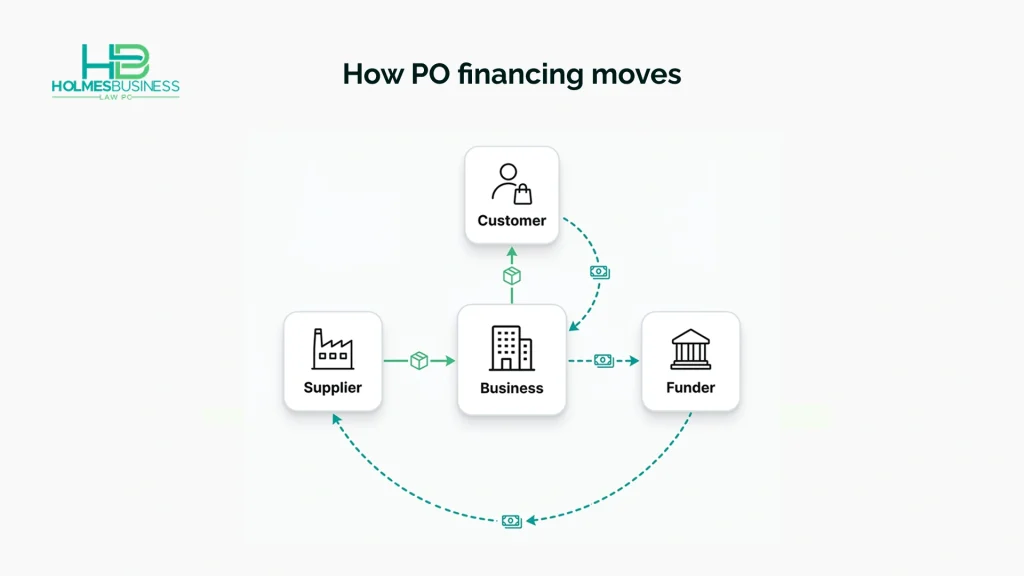
Purchase order financing is a transaction in which a financing company funds some or all of the supplier cost required to complete an approved customer order.
It is commonly used by businesses that sell physical goods and receive an order larger than their available working capital can support. The financing company usually pays the supplier directly rather than depositing unrestricted cash into the business’s operating account.
The customer later pays the financing company or a controlled account. The financing company deducts the amount advanced, its fees, and any other permitted charges. The remaining funds are released to the business.
Purchase Order Financing Is Not Acquisition Financing
Purchase order funding helps a business fulfill customer orders. It generally does not fund the purchase price of buying another company.
A business acquisition may instead involve a bank loan, seller financing, investor capital, or another acquisition-financing structure. Those transactions use different documents and allocate different risks.
The Contract Label Does Not Decide the Risk
The documents may describe the arrangement as financing, funding, an advance, a purchase, or a secured transaction.
The title alone does not tell you:
- Whether repayment is required
- What happens after a customer dispute
- Which assets secure the obligation
- Whether an owner is personally liable
- Who controls customer payments
- Which remedies become available after default
The operative provisions control those issues. Read the definitions, schedules, incorporated documents, and guaranties along with the main agreement.

How Does Purchase Order Financing Work?
A typical purchase order financing transaction involves four parties: your business, your customer, your supplier, and the financing company.
The Typical Process
- Your customer issues a purchase order.
- You obtain a supplier quote or production invoice.
- You submit the proposed transaction to a financing company.
- The financing company evaluates the customer, supplier, order, and expected margin.
- If approved, the financing company pays the supplier directly or through an agreed method.
- The supplier manufactures, purchases, or ships the goods.
- Your customer receives the goods and an invoice.
- The customer sends payment to the financing company or a controlled account.
- The financing company deducts its advance and charges.
- The remaining proceeds are released to your business.
Approval may be transaction-specific. A financing company can approve one purchase order without committing to fund the next one.
The Four Parties Have Different Obligations
Your customer’s purchase order governs matters such as product specifications, delivery, inspection, acceptance, cancellation, returns, and payment.
Your supplier agreement governs production, cost, shipping, defects, refunds, and timing.
The purchase order financing agreement governs funding, fees, recourse, payment control, collateral, default, and remedies.
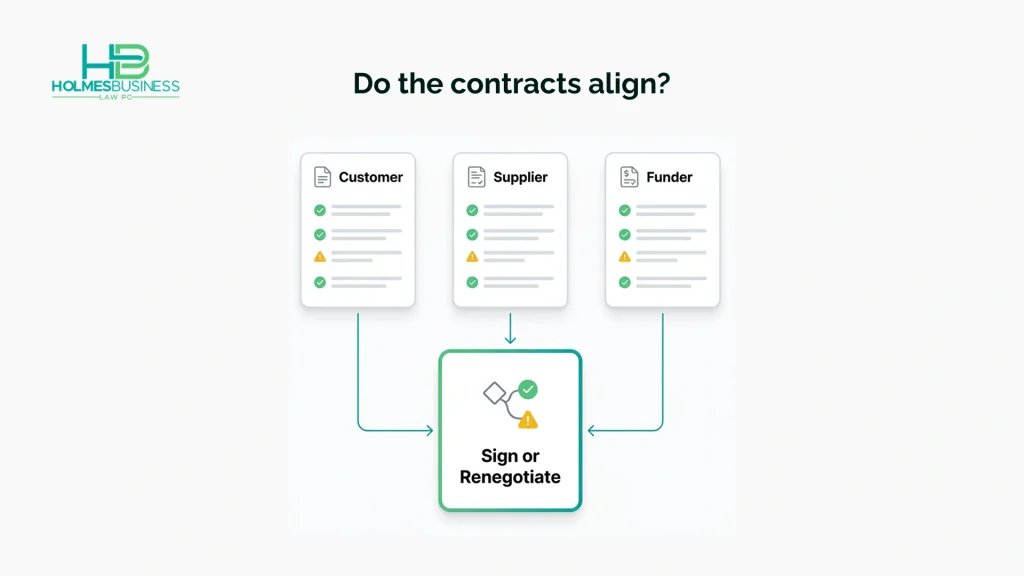
Those documents must work together. A financing agreement may require repayment following a customer dispute while the customer’s purchase terms give the customer broad rights to reject goods or offset other claims.
Order-to-Payment Risk Map
| Transaction Stage | Main Document | Primary Risk |
| Customer places the order | Customer purchase order | Cancellation, offset, acceptance, or assignment terms |
| Supplier accepts production | Supplier quote or agreement | Delay, defects, shipping, or refund rights |
| Financing company pays | Financing agreement | Fees, recourse, collateral, or guaranties |
| Goods are delivered | Shipping and acceptance records | Rejection, shortage, damage, or late delivery |
| Customer pays | Assignment notice and account instructions | Late, disputed, or misdirected payment |
Before signing, identify who bears each risk if the transaction does not proceed as planned.
What Does Purchase Order Financing Really Cost?
A quoted percentage does not show the complete cost unless you know how the percentage is calculated and which additional charges apply.
Questions to Ask About the Fee
Review the agreement for:
- The amount on which the fee is calculated
- The date on which fees begin
- Whether fees accrue daily, weekly, or in fixed periods
- Whether a partial period is rounded up
- Whether there is a minimum financing period
- Whether fees continue during a customer dispute
- Whether unpaid charges compound
- Whether the rate changes after a specified date
- Whether unused-facility or minimum-volume fees apply
A fee described as “5 percent per month” could work differently from a daily fee that produces a similar headline number. A new full fee period may begin when payment arrives one day after a deadline.
Additional Charges to Identify
The agreement or related documents may also permit:
- Application or diligence fees
- Supplier-inspection fees
- Wire charges
- Document-preparation fees
- Legal expenses
- Letter-of-credit charges
- Lockbox or account fees
- Renewal fees
- Default charges
- Collection and enforcement costs
Ask for a written schedule showing every charge that may apply to the proposed order.
Worked True-Cost Example
Assume the following hypothetical transaction:
| Item | Amount |
| Customer purchase order | $100,000 |
| Supplier cost | $65,000 |
| Shipping and inspection | $4,000 |
| Expected margin before financing | $31,000 |
Assume solely for illustration that the financing agreement charges 10 percent of the funded supplier cost for the first 30-day period and another 5 percent if payment falls into a second period.
| Financing Cost | Amount |
| First-period charge | $6,500 |
| Additional-period charge | $3,250 |
| Total illustrative financing charge | $9,750 |
| Remaining margin before overhead, returns, and taxes | $21,250 |
The financing charge consumes more than 31 percent of the expected $31,000 margin. A return, credit, customer offset, or additional delay could reduce the remaining profit further.
These figures are hypothetical. They are not quoted market terms.
Compare Cost With Expected Profit
Do not compare the financing cost only with total order revenue.
Use this calculation:
Customer payment minus supplier cost, freight, inspection, financing charges, reserves, expected returns, commissions, and internal fulfillment costs.
The remaining amount is the order’s contribution before general overhead and taxes.
A $100,000 order may look attractive while producing little usable profit. Calculate the expected result for an on-time payment and for a delayed or disputed payment.

Is the Purchase Order Financing Agreement Recourse or Nonrecourse?
Recourse determines whether the financing company can require your business to repay or repurchase the funded transaction after specified events.
What Does Recourse Mean?
A recourse provision may require repayment if:
- The customer disputes the invoice
- The customer asserts an offset
- Goods arrive late
- Goods do not meet specifications
- The customer rejects or returns the goods
- The supplier fails to perform
- Documents contain inaccurate information
- The order is cancelled
- The customer becomes insolvent
- Payment is not received by a stated deadline
One purchase order financing form filed with the SEC gave the financing company immediate full recourse after several events. Those events included failure to fill and invoice an order within 45 days, a customer dispute, an alleged offset, incorrect order information, and circumstances the financing company believed could threaten payment. The same form allowed chargebacks, setoff, direct customer notification, and secured-party remedies. This is one publicly filed contract example, not a statement that every agreement contains those terms.
What Does Nonrecourse Mean?
A nonrecourse arrangement may leave a limited category of credit risk with the financing company. For example, it may cover an approved customer’s inability to pay because of insolvency.
That protection may not cover:
- Product-quality disputes
- Customer returns
- Late delivery
- Breach of warranty
- Incorrect documents
- Fraud
- Cancellation
- Supplier nonperformance
- Contract violations
- Offsets involving another transaction
The word “nonrecourse” is not enough. Read every exception and every definition tied to it.
Recourse Questions to Ask
| Event | Contract Question |
| Customer pays late | Do fees continue, and when does recourse begin? |
| Customer disputes quality | Must the business repay before the dispute is resolved? |
| Supplier ships late | Is the business responsible even when the supplier caused the delay? |
| Customer becomes insolvent | Is that specific credit risk covered by the financing company? |
| Customer asserts an offset | Does an allegation trigger recourse, or must the offset be valid? |
| Order is cancelled | Who absorbs supplier costs, financing charges, and freight? |
| Goods are returned | Must the business repurchase the funded receivable or order? |
Consider the worst contractually permitted outcome, not only the expected outcome.
Who Controls the Customer’s Payment?
Purchase order financing frequently requires the customer to send payment directly to the financing company, a lockbox, or another controlled account.
That arrangement affects more than payment routing. It can affect customer communications, disputes, collection decisions, and the business’s relationship with a major customer.
How Does a Notice of Assignment Work in Pennsylvania?
Pennsylvania Commercial Code Section 9406 states that an account debtor may generally discharge its obligation by paying the assignor until it receives a signed notification that the amount due has been assigned and payment must be made to the assignee. After effective notification, the account debtor generally must pay the assignee to discharge the obligation.
The notice must reasonably identify the assigned rights. If the customer requests reasonable proof of the assignment, the assignee must seasonably provide it or the customer may continue paying the assignor under the statute. The section contains exceptions and special rules that may affect a particular transaction.
Review the proposed notice before it goes to the customer. Confirm that the customer name, order, invoices, payment instructions, and effective date are correct.
Can the Financing Company Contact the Customer?
The agreement may authorize the financing company to:
- Verify the purchase order
- Confirm product delivery
- Send assignment notices
- Provide payment instructions
- Discuss an invoice dispute
- Demand payment
- Negotiate a settlement
- Collect directly after default
- Notify other customers of its rights
One SEC-filed form authorized the financing company to direct account debtors to pay it and allowed it to settle a customer dispute, while leaving the client responsible for full payment under the form.
Ask who controls communications before and after default. A collection message sent to an important customer can affect a relationship your business spent years building.
What Happens if the Customer Pays Your Business?
The agreement may require you to hold a misdirected payment in trust and transfer it immediately to the financing company.
It may also treat retention, deposit, or use of the payment as a default. Your accounting and customer-service teams should know where funded customers must pay and what to do with a payment received by mistake.
What Collateral Is the Business Giving the Financing Company?
The financing company may require a security interest in assets connected to the funded order. Some agreements reach further.
Is the Lien Limited to One Order?
Possible collateral includes:
- The funded purchase order
- Inventory acquired with the advance
- Goods in production or transit
- Accounts created by the sale
- Customer payments and other proceeds
- Insurance proceeds
- Books and records
- Deposit accounts
- Related contract rights
- Other present or future business assets
One SEC-filed purchase order financing agreement granted a continuing security interest in eligible purchase orders and authorized the secured party to file UCC financing statements and amendments. The secured obligations included principal, interest, fees, and expenses under that agreement.
Review the actual collateral definition. A short financing statement may refer to a broader security agreement that defines the secured assets and obligations.
What Is a Blanket Lien?
A blanket lien may cover most or all business assets rather than one financed order.
That can affect:
- Existing lender requirements
- Future borrowing
- Equipment financing
- Sale of business assets
- Refinancing
- Investor transactions
- The company’s ability to grant another security interest
Search for existing liens before signing. Your current lender may prohibit additional debt or liens without consent.
What Are Cross-Collateralization and Cross-Default?
Cross-collateralization means the same collateral secures more than one obligation.
Cross-default means a default under one contract creates a default under another.
Together, those clauses can allow a problem involving one order or another lender to affect the entire financing relationship.
Pennsylvania UCC Filing and Search Fees
Pennsylvania currently lists an $84 fee for a financing statement or financing-statement amendment. A UCC information request costs $12 per debtor name. Copies cost an additional $3 per page, and certification adds $28.
The Department of State states that debtor names are indexed exactly as they appear on the financing statement. Entity-name accuracy matters when filing and searching.
Fees and filing procedures can change. Recheck them before submitting a filing or ordering a search.
Are You Signing a Personal Guaranty?
A personal guaranty can make an owner individually responsible even though the business is the financing company’s primary client.
Read the guaranty as a separate agreement. Do not assume the limitations in the main financing document automatically limit the guarantor’s exposure.
What Does the Guaranty Cover?
A guaranty may cover:
- Funded principal
- Financing fees
- Default charges
- Indemnification obligations
- Collection costs
- Attorneys’ fees
- Future transactions
- Renewals, modifications, and extensions
It may guarantee payment, performance, or both.
Must the Financing Company Pursue the Business First?
Some guaranties allow the financing company to proceed directly against the owner without first:
- Suing the business
- Collecting from the customer
- Enforcing the lien
- Selling collateral
- Pursuing another guarantor
Review any waiver of presentment, demand, notice, marshaling, or exhaustion of remedies. Those terms can remove procedural protections the owner expected to have.
Can the Guaranty Be Terminated?
Check:
- How termination notice must be delivered
- When termination becomes effective
- Whether existing orders remain covered
- Whether later fees and renewals remain covered
- Whether the guaranty survives the main agreement
- What written release is required
Stopping future financing does not necessarily release liability for existing transactions.
Which Default and Remedy Clauses Need Careful Review?
Default may include much more than failure to pay money when due.
Potential Events of Default
The agreement may treat the following as defaults:
- A late customer payment
- A customer dispute
- Missed shipping or delivery deadlines
- A false or inaccurate representation
- Failure to provide financial reports
- Failure to notify the financing company of a dispute
- An unauthorized lien
- New debt without consent
- A change in ownership
- A lawsuit, judgment, or tax lien
- Insolvency
- Default under another agreement
- A material adverse change
- Interference with customer collection
- Violation of a covenant
Terms such as “material adverse change” deserve attention because they may depend on the financing company’s judgment about a developing risk.
Remedies After Default
The financing company may be permitted to:
- Stop funding new orders
- Demand immediate repayment
- Charge additional fees or interest
- Apply reserves or other balances
- Set off money otherwise payable to the business
- Require repurchase of a funded order
- Contact and collect from customers
- Enforce its security interest
- Recover legal and collection expenses
- Terminate the facility
A default under one order may also trigger remedies affecting every outstanding order.
Is There Notice and Time to Cure?
A cure period gives the business time to fix a specified default.
Review:
- Which defaults require notice
- How notice may be sent
- When notice is effective
- How long the cure period lasts
- Which defaults have no cure right
- Whether repeated defaults lose the cure period
- Whether an order dispute triggers immediate recourse
A ten-day cure period is not useful if the agreement permits the financing company to contact customers and stop funding immediately.
Does the Agreement Restrict Other Financing?
A purchase order financing agreement may limit the business’s ability to use another financing source.
Exclusivity and First-Look Rights
The agreement may require the business to:
- Submit all eligible orders to one financing company
- Give the financing company the first opportunity to fund
- Obtain consent before using another funder
- Meet minimum transaction volumes
- Avoid granting competing liens
- Use related factoring services
- Pay a fee for placing orders elsewhere
A transaction-specific approval is different from a facility that controls future orders. Identify which arrangement the contract creates.
Can the Business Terminate?
Review:
- The initial contract term
- Automatic renewal
- The required termination notice
- The address and delivery method for notice
- Minimum fees
- Early termination charges
- Treatment of pending orders
- Continuing indemnities
- Release of customer-payment instructions
- UCC termination obligations
A financing relationship is not fully closed until outstanding obligations are paid, controlled accounts are released, customer instructions are corrected, and liens are properly addressed.
Which Documents Should an Attorney Review Together?
The financing agreement should be reviewed as part of a document stack.
| Document | What It Controls |
| Customer purchase order | Price, quantity, specifications, delivery, acceptance, cancellation |
| Incorporated customer terms | Warranties, offsets, disputes, returns, assignment |
| Supplier quote or agreement | Production, price, shipping, defects, refunds |
| Purchase order financing agreement | Approval, funding, fees, recourse, default, remedies |
| Security agreement | Collateral and secured obligations |
| Personal guaranty | Owner’s individual exposure |
| Notice of assignment | Where and how the customer must pay |
| UCC financing statement | Public notice of a claimed security interest |
| Lockbox or account agreement | Control and release of customer payments |
| Insurance documents | Coverage for inventory, shipping, and proceeds |
Look for Inconsistent Obligations
Examples include:
- The customer can cancel at any time, but the business must repay all financing charges after cancellation.
- The supplier disclaims delivery responsibility, but the financing agreement makes the business responsible for every delay.
- The customer has broad offset rights, while any alleged offset creates immediate recourse.
- The financing agreement requires assignment, while the customer contract contains restrictive assignment language.
- The security agreement covers all assets, while an existing loan prohibits additional liens.
- The guaranty continues indefinitely, while the main agreement appears to have ended.
A single document may appear manageable while the combined document stack creates a different result.
What Should You Ask Before Signing?
Use the following checklist to identify terms that need clarification or negotiation.
Cost
- What is the expected dollar cost if the customer pays on time?
- What is the expected cost if payment is 15, 30, or 60 days late?
- What starts a new fee period?
- Are partial periods rounded up?
- Are there minimum-volume or unused-facility charges?
- Which diligence, legal, wire, inspection, or collection costs are additional?
- Do fees continue during a dispute?
Recourse
- Which events require repayment or repurchase?
- Is a customer allegation enough to trigger recourse?
- Does the financing company bear any customer credit risk?
- Who bears supplier delay or product-defect risk?
- Does recourse include all fees and enforcement costs?
- How quickly must repayment be made?
Customer Control
- Who prepares and sends the notice of assignment?
- Where must the customer pay?
- Can the financing company contact the customer before default?
- Can it negotiate or settle a customer dispute?
- What happens if the customer pays the business by mistake?
- How are payment instructions withdrawn after payoff?
Collateral and Guaranties
- Is the lien limited to the funded order?
- Does the collateral include all accounts, inventory, or business assets?
- Are future obligations secured?
- Does the agreement create cross-collateralization or cross-default?
- Is an owner signing personally?
- How and when are the lien and guaranty released?
Default and Exit
- What triggers default?
- Which defaults depend on the financing company’s judgment?
- Is there notice and a cure period?
- Can one failed order default the entire facility?
- Does the contract renew automatically?
- Is there an early termination fee?
- What survives termination?
- Who files the UCC termination statement?
When Does Attorney Review Add the Most Value?
Contract review is most useful before the agreement is signed, the customer is notified, and the financing company pays the supplier.
Review deserves particular attention when:
- An owner must sign a personal guaranty
- The financing company receives a blanket lien
- The agreement is described as nonrecourse but contains broad exceptions
- Customer-payment rights will be assigned
- The financing company may contact or collect from customers
- The total cost is difficult to calculate
- The arrangement is exclusive
- Default terms reach beyond missed payments
- Customer and supplier contracts do not align
- One order represents a large share of expected revenue
- Another lender already has a lien
- The business must reimburse legal or enforcement expenses
Federal Regulation Z generally exempts credit extended primarily for business, commercial, agricultural, or organizational purposes. The current rule specifically gives a loan used to expand a business as an example of business-purpose credit. A business owner should not assume that a commercial financing agreement will present costs in the standardized manner associated with many consumer-credit transactions.
Holmes Business Law provides business financing agreement review for Pennsylvania companies. The review can address fees, guaranties, collateral, payment controls, default terms, remedies, and inconsistencies across related documents. The firm’s financing practice specifically addresses loan agreements, security agreements, guaranties, UCC-related documentation, and lender remedies.
Frequently Asked Questions
Purchase order financing provides funds to pay a supplier for goods needed to fulfill a confirmed customer order. The financing company commonly pays the supplier directly and receives repayment from the customer’s eventual payment. The agreement determines fees, recourse, collateral, and payment control.
It may be structured as a secured loan, an advance, a purchase of rights, or another commercial financing arrangement. The contract label does not answer whether repayment is required. Review the economic terms, recourse provisions, security interest, assignment language, and remedies.
Purchase order financing generally supplies funds before goods are produced or delivered. Invoice factoring generally involves an invoice created after goods or services have been delivered.
Some transactions use both. The PO financing company may fund the supplier, and a factor may later purchase or collect the resulting invoice. Review both agreements for overlapping fees, liens, payment rights, and defaults.
The cost depends on the agreement, funding period, supplier amount, customer payment timing, and additional fees. Calculate the total expected dollar cost under on-time, delayed, and disputed-payment scenarios. Compare that amount with the order’s expected profit, not only its revenue.
The customer commonly pays the financing company or a controlled account after receiving the goods. The financing company deducts the advance and charges before releasing the remaining proceeds. The documents should state what happens if the customer pays the business directly.
Fees may continue to accrue, a new minimum period may begin, or the delay may trigger recourse or default. The exact result depends on the agreement. Calculate delayed-payment costs before signing and confirm whether the business must repay before receiving customer funds.
The business may have to resolve the dispute, replace the goods, issue a credit, or repay the financing company. A nonrecourse description may exclude product, delivery, warranty, and acceptance disputes. Compare the financing agreement with the customer’s inspection and rejection rights.
Some arrangements may be nonrecourse for a limited customer credit risk, but retain recourse for disputes, returns, delays, incorrect information, or contract breaches. Read every exception. Ask whether an allegation alone triggers repayment or whether the financing company must establish a valid claim.
Yes, a financing arrangement may authorize a UCC financing statement covering specified collateral. The security agreement determines the collateral and obligations. Pennsylvania currently charges $84 for a financing statement and $12 per debtor name for a UCC information request.
Some financing companies require one and others may not. A guaranty can cover principal, fees, indemnities, legal costs, and future transactions. Review whether the financing company can proceed directly against the owner and how the guaranty can be terminated.
Often, yes. The customer may receive a verification request, notice of assignment, or instructions to pay the financing company or a controlled account. Review who may contact the customer, what information may be disclosed, and how payment instructions end after payoff.
Legal review is particularly useful when the documents include a personal guaranty, security interest, customer-payment assignment, broad recourse, exclusivity, or aggressive default remedies. Counsel can also compare the financing terms with the customer purchase order, supplier agreement, and existing loan documents.
Key Takeaways / TLDR:
- Purchase order financing can fund supplier costs, but it does not guarantee that an order will be profitable.
- Calculate fees in dollars under on-time, delayed, and disputed-payment scenarios.
- Read every exception to a nonrecourse description.
- Compare the financing agreement with the customer purchase order and supplier agreement.
- Confirm who controls customer communications and payments.
- Identify whether the lien is transaction-specific or covers broader business assets.
- Review personal guaranties separately from the main agreement.
- Check default, cross-default, exclusivity, renewal, and termination terms.
- Confirm how customer notices, controlled accounts, guaranties, and UCC filings will be released.
- Complete legal review before signing or notifying the customer.
Purchase order funding should solve a timing problem without creating an exposure the order’s profit cannot support. The business should understand the expected transaction and the contract’s treatment of a failed transaction before committing