
Most small businesses don’t run into trouble because of a bad product or weak marketing. They run into trouble because of a contract they barely read, didn’t understand, or copied from somewhere online.
At first glance, contract templates surely feel like a smart shortcut. While they are quick, cheap, and widely available, it ultimately depends on the business requirements. But what many business owners discover too late is that a poorly drafted contract can cause massive damage to their business in the long run.
An average of 9.2% of annual revenue is simply lost due to poor contract management. This is where the decision between using a template and hiring a business contract attorney becomes critical. It is not just about saving money upfront. It is about avoiding costly mistakes later.
In this guide, we will break down where templates work, where they fail, and how working with a professional like Holmes Business Law can protect your business in ways a generic document never will.
What Small Businesses Get Wrong About Contracts?
One of the biggest misconceptions among small business owners is that contracts are just formalities. Something you sign to make things “official.” In reality, a contract is a risk management tool. It defines responsibilities, protects your interests, and determines what happens when things go wrong.
Many businesses assume the following:
- A written agreement is enough, regardless of quality
- Templates are legally safe because they are widely used
- Contracts only matter in extreme disputes
These assumptions often lead to gaps that only become visible during conflict. By then, fixing them is expensive, stressful, and sometimes impossible.
Contract Templates: Why They Are Popular?
It is easy to understand why templates are appealing. There are several advantages that lure business owners, such as:
- Low-cost or even completely free
- Instantly accessible
- Easy to customize at a basic level
For a small business trying to control expenses, templates feel like a practical solution. You can download one, tweak a few details, and start working immediately.
In some cases, this approach works. But the problem is that most business owners do not know when it is safe and when it is risky.
When Templates Actually Work?
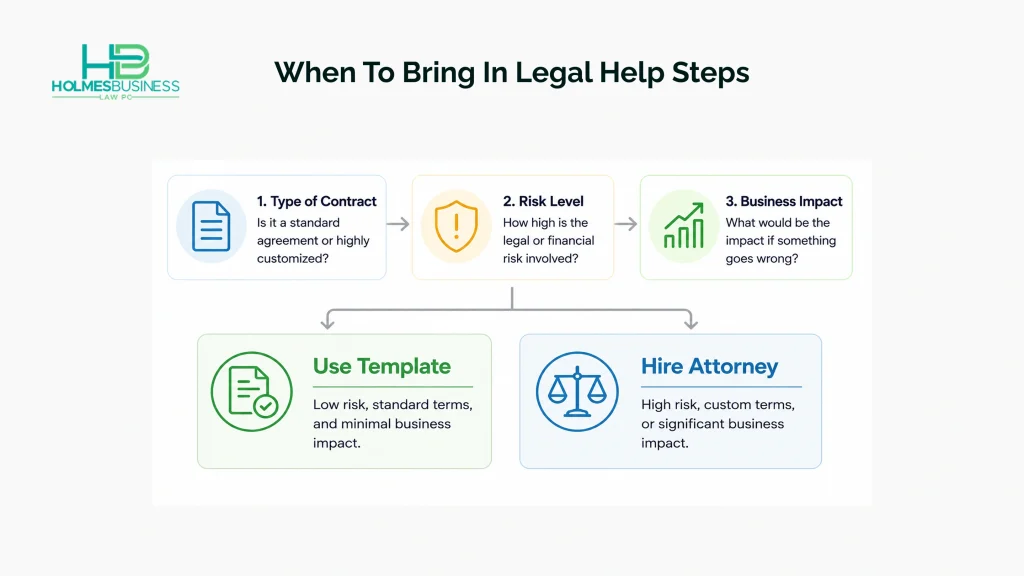
Templates are not necessarily a bad choice. They can be useful in different low-risk situations where the stakes are limited for your business. You can go for templates at this time.
For example:
- Simple service agreements with small payments
- One-time transactions with clear deliverables
- Internal documents that do not involve external liability
In such scenarios, the risk of legal complications is comparatively low. Even if something goes wrong, the financial impact will surely be manageable for your business.
However, the moment your business grows, takes on higher-value contracts, or involves multiple parties, templates may not be sufficient. This is where a business contract attorney comes into the picture.
Where Templates Go Wrong?
Templates are never customized. They are designed for generic audiences. However, most businesses need customization. Here are some common reasons why templates may not work for your company’s legal matters.
- Generic Language Creates Risk
Most templates use broad, vague wording. While this makes them flexible, it also makes them open to different kinds of interpretation. In a dispute, unclear language can actually weaken your position.
- No Industry Context
Every industry has its own set of risks. A generic template does not really account for these aspects. Whether it is intellectual property, liability exposure, or compliance requirements, there is not enough industry exposure.
- Missing Critical Clauses
Many templates lack key protections, such as:
- Limitation of liability
- Indemnification clauses
- Clear termination terms
- Dispute resolution mechanisms
Without these, you are exposed in ways you may not even realize.
- Jurisdiction Problems
Contracts need to comply with local laws. A template downloaded online may not align with Pennsylvania regulations, which can affect enforceability.
Real Situations Where Businesses Get Burned
There are several instances where poorly drafted contracts end up drowning the business in legal matters in the long run. This is where the difference becomes real. Let’s discuss them further in a more detailed manner.
- Payment Disputes
A vague payment clause can directly lead to delayed payments or even non-payment issues. Without clear penalties or enforcement mechanisms, collecting dues becomes difficult.
- Vendor Failures
If a vendor fails to deliver, a poorly written contract may not clearly define any remedies or accountability. This way, your business might need to handle the loss ultimately.
- Partnership Conflicts
Many partnerships start with trust and a basic agreement. When disagreements arise, the lack of clear roles and exit terms often leads to disputes.
- Intellectual Property Confusion
Without any precise clauses, the ownership of work, designs, or content can indeed become unclear or confusing. This can create long-term legal complications.
These situations are not rare. They are common and costly. This is why your business needs to step up and implement a real backup solution to address such legal issues.
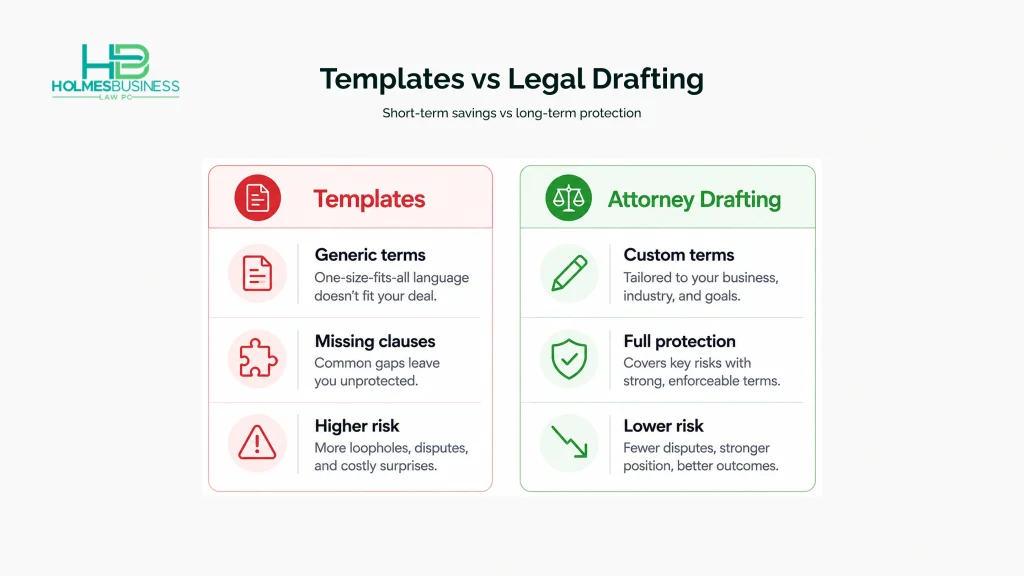
Drafting vs Templates
Templates may surely save money upfront, but they often create hidden costs later. Templates offer convenience and speed, but lack the much-needed customization and legal depth. They rely on assumptions and generalizations.
Attorney-drafted contracts, on the other hand, are always customized and built around your business. They provide clarity, reduce risk, and improve enforceability. The difference is not just in quality, but in long-term protection.
| Aspect | Attorney‑Drafted Contracts | Contract Templates |
| Precision & Customization | Built around your business model, industry, and risk exposure. Clauses reflect real operations and contingencies. | Identifies hidden liabilities, payment terms, IP ownership, indemnities, and dispute resolution. |
| Risk Management | Higher upfront cost, but prevents costly disputes later. | Misses nuanced clauses; leaves loopholes that can void protection. |
| Legal Validity | Reviewed for compliance with current laws and local regulations. | Often outdated or jurisdiction‑neutral; may conflict with statutory requirements. |
| Negotiation Power | Strengthens your position in vendor or client negotiations. | Weak leverage—counterparties exploit vague or missing clauses. |
| Cost vs Value | Cheap initially, but expensive when conflicts arise. | Quick download and fill‑in, but time was lost fixing issues later. |
| Time Investment | Collaborative drafting ensures clarity and long‑term usability. | No accountability, the template provider isn’t responsible for your losses. |
| Accountability | Backed by professional liability and legal expertise. | No accountability, template provider isn’t responsible for your losses. |
| Scalability | Evolves with your business growth and new regulations. | Static; manual edits risk inconsistency and invalidation. |
When Should You Hire a Business Contract Attorney?
Not every situation requires legal help, but certain triggers should not be ignored. You should always consider hiring an attorney when:
- The contract involves significant financial value
- You are entering a long-term agreement
- Multiple parties are involved
- Intellectual property is part of the deal
- You are scaling your business
- You are unsure about legal terms
If you are soon entering a high-value deal, such as buying or selling a company, working with legal counsel during a business purchase or sale is essential to avoid potential hidden liabilities.
Costs of Not Hiring a Lawyer
Many businesses avoid hiring a business contract lawyer to save money. Ironically, this decision often leads to greater expenses.
Common consequences include:
- Legal disputes and litigation costs
- Lost revenue due to unclear terms
- Damaged business relationships
- Time spent resolving preventable issues
A poorly written contract does not just fail to protect you. It can create new problems that did not exist before.
Why Should You Choose a Holmes Business Contract Attorney?
When your contracts are tied to your revenue, partnerships, and day-to-day operations, you will always need someone who understands how small businesses actually work, not just how the law reads on paper. Here are a few aspects you must always consider:
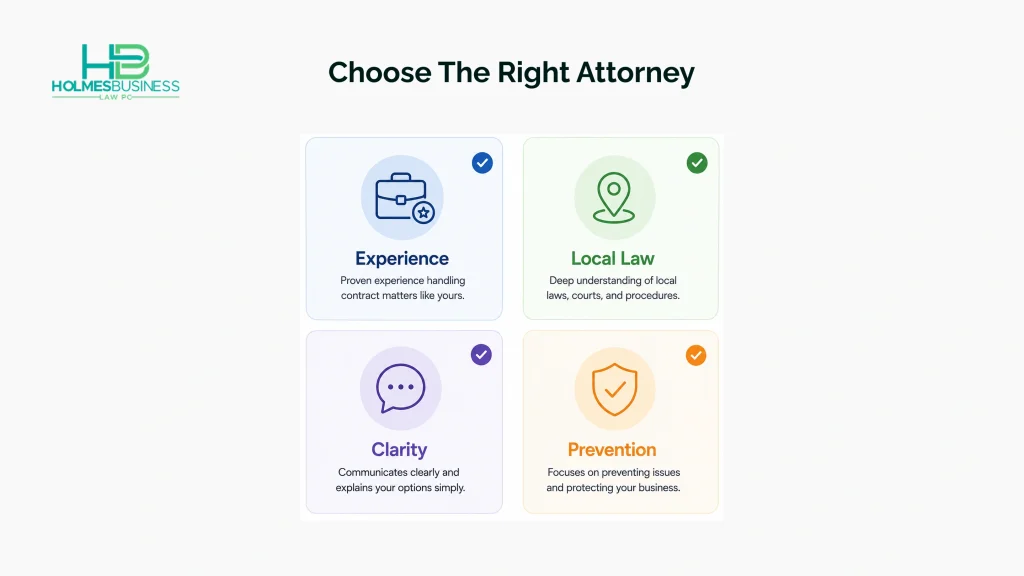
- Experience working with small businesses truly helps, especially for small business owners. They understand the pressure of making quick decisions, managing costs, and still needing contracts that actually hold up when something goes wrong.
- Hands-on experience in drafting, reviewing, and negotiating ensures that your business contract lawyer is not just drafting the contracts randomly. They must be able to review the agreements thoroughly, identify risks, and step in during potential negotiations to ensure your business is never jeopardized.
- They should have familiarity with Philadelphia and Pennsylvania business laws. Local knowledge matters more than most people think, because highly valuable contract enforceability can only depend on state-specific rules, and having someone who understands how things work in Pennsylvania gives you an extra layer of confidence.
- Clear communication without any legal jargon is extremely important. A good attorney will never bury you in complicated language. They will always explain what each part of the contract actually means for your business, so you know exactly what you are agreeing to before you sign anything.
- They should always have straightforward pricing and honest advice. This will help you avoid any vague billing or surprise costs.
- They must always have a practical, preventive approach to all contracts. The right attorney will never wait for a dispute to happen. They will always help you think through risks in advance, tighten your agreements, and put protections in place so you are never left dealing with avoidable problems later.
A good business contract attorney like Holmes Business Law is not just there for emergencies. They become someone you can always rely on as your business grows, helping you make better decisions and avoid issues in contracts before they even start. This is truly important, especially when you are dealing with multiple deals at the same time.
FAQs
Yes, templates can be legally valid, but their effectiveness depends on how well they fit your specific situation. A poorly adapted template can still create legal risks.
As soon as contracts involve higher value, multiple parties, or long-term commitments, it is safer to move away from templates.
The upfront cost may seem higher, but it is often far less than the cost of disputes or legal issues caused by weak contracts.
Yes, many attorneys offer contract review services, which can improve a template while keeping costs lower than full drafting.
The biggest risk is missing or unclear clauses that leave your business unprotected during disputes.
Yes, contracts must comply with local laws. Using a generic template that does not align with state regulations can affect enforceability.
Contracts should be reviewed regularly, especially when your business grows or your services change.
Conclusion
Choosing between templates and a business contract attorney is not just any random financial decision. It should always be a strategic one. Templates may surely work for simple situations, but they are no longer enough when your business starts to grow or faces real risks in the industry. This is why a well-drafted contract is the better choice. It provides clarity, protection, and peace of mind.
This is why most business owners rely on good business contract attorneys like Holmes Business Law. They always handle all relevant contracts before and after you sign them. This is the best way to ensure that your contracts are always well-drafted with the right expertise. This prevents potential risks of fraud, damage, or even massive revenue loss.
Key Takeaways:
- Templates may always sound cost-effective, but they are not the best choice for most businesses. They surely lack a lot of precision that is required to truly protect your business in various complex situations. Over time, this can eventually lead to expensive disputes.
- A contract drafted by a professional attorney is always tailored to your business and reduces potential confusion that may arise later. This makes it way easier to enforce and defend if issues arise.
- As your business gradually expands, so do the stakes involved in your agreements. What worked at an early stage may no longer be sufficient when it comes to drafting contracts.
- Clear, well-written contracts effectively reduce misunderstandings and protect relationships in industries. They act as a safeguard when expectations are not met or unprecedented situations occur.
- Hiring a business contract attorney is not just a mere optional expense. It is an invaluable investment that will guarantee lifetime stability and growth. It helps you avoid all kinds of potential problems instead of fixing them later.