


As your business expands, legal decisions become constant rather than optional. Contracts, constants, partnerships, and conflicts-all of these require clarity and precision. Looking for a corporate attorney near me often starts when something urgent happens, but the fact is, the appropriate legal counsel should be part of the strategy before the issue arises.
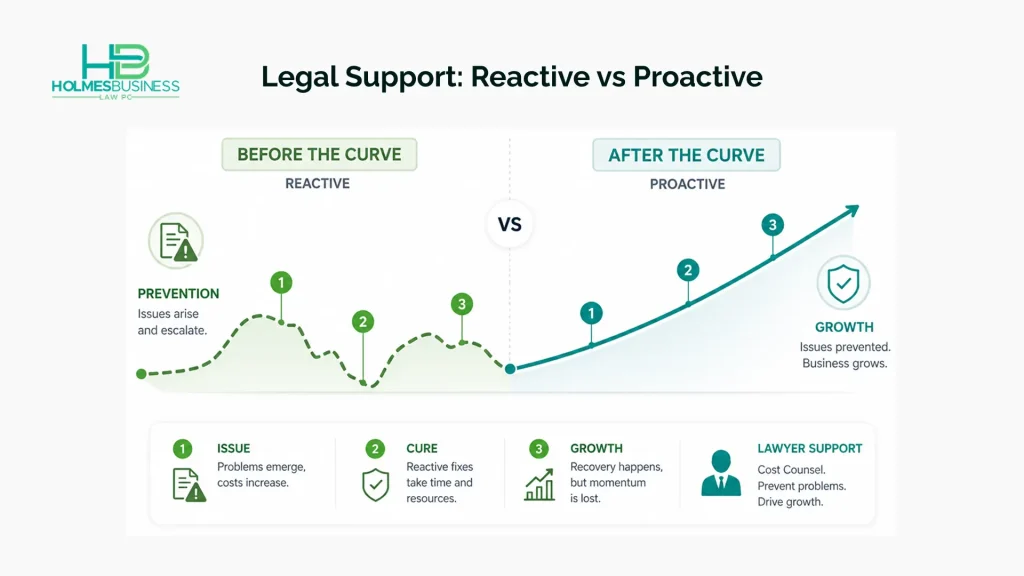
Studies show that 82% of companies were involved in at least 1 lawsuit in 2024, with litigation costs for large organizations averaging $4.3 million per year, underscoring the expense of reactive legal approaches. Also, organizations that combine legal advisors into strategic decision-making achieve stronger deal outcomes and fewer operational disputes.
This is where the partners like Holmes Business Law come in. Instead of entering during crises, the approach to corporate and general counsel emphasizes continuous advisory support, helping businesses stay flexible and manage risks before they arise.
This guide will help you to understand what to look for, what to avoid, and how to choose counsel that supports long-term business success.
What is the Role of a Corporate Attorney?
The corporate attorney advises organizations on their legal rights and responsibilities. When they are hired by an organization, the corporate attorneys represent the corporation rather than the shareholders or employees. The major roles of a corporate attorney near me are:
- Contracts
Corporate attorneys help clients adhere to and make decisions based on recent contracts. One of the important responsibilities of corporate attorneys is to write, review, and negotiate legal contracts for the clients.
- Representation
They represent their clients in court during board or regulatory meetings. For instance, when an organization faces a lawsuit from a customer, the corporate attorney near me may design a defense.
- Corporate Governance
A corporate attorney near me helps clients to develop a framework to manage their organization and its operations. These responsibilities include developing bylaws and management policies and offering legal guidance to directors and board members.
- Securities
Securities regulations apply to publicly traded organizations and aim to minimize insider trading, market manipulation, and other fraudulent activities. Corporate attorneys ensure there is a solid estate plan, help them register with the federal government, and prepare reports related to stocks and disclosures.
Companies hire mid-career or aspiring leaders to make decisions and ensure those decisions comply with relevant laws and regulations.
Why Businesses Search For A Corporate Attorney Near Me?
In recent years, understanding the role of corporate attorneys has become non-negotiable for business owners. A corporate attorney near me is not only a legal representative but also a strategic advisor who helps businesses manage risks, reduce conflicts, and stay compliant. Business search corporate attorney to-
- Prevent regulatory violations.
- Minimize conflicts efficiently.
- Safeguard shareholder value.
- Navigate collapse and restructuring.
- Develop long-term legal stability.
Therefore, organizations that depend on corporate attorneys are better positioned to survive and grow in rapidly changing business environments.
Areas Where Corporate Counsel Adds Value
Corporate counsel adds value by transforming from a ‘no’ department into a strategic business partner. They focus on anticipatory risk reduction, operational efficiency, and commercial acceleration rather than legal compliance. The key areas include:
- Strategic business partnership
Rather than just identifying risks, internal counsel examines them, identifies alternatives, and helps structure deals to align with the company’s goals.
- Anticipatory compliance
By understanding the industry, they identify regulatory trends early and reduce risk before they become an expensive mistake.
- Cost efficiency
Counsels minimize legal spend by optimizing legal efforts, adopting new techniques, and implementing low-value tasks for internal departments.
- Commercial enablement
Instead of saying ‘no’, counsel helps businesses discover legal and safe ways to achieve commercial goals using a yes-focused approach to boost solutions.
How To Choose The Right Corporate Attorney?
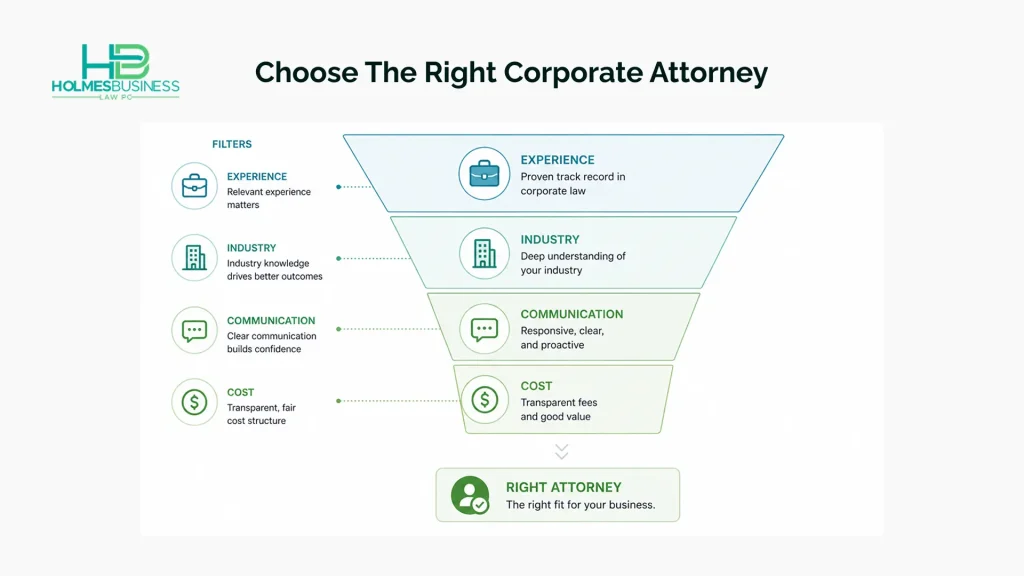
If you want to run a successful business, a reliable and knowledgeable corporate attorney is the first and foremost requirement. But finding a suitable corporate attorney for your organization can be a monotonous task. Therefore, before choosing the perfect lawyer, keep the following things in mind.
- Examine the legal needs
Before beginning the search for a corporate attorney, it is important to assess your organization’s specific legal needs. Discover the legal services for new business is likely to be met, such as agreements, intellectual property, and other regulatory compliance. By identifying your legal needs, you can filter your search and find a suitable lawyer with the expertise you need.
- Industry experience
When choosing a corporate lawyer, the business formation experience and skill set should be your top priorities. Select a lawyer who is an expert in business formation and has proven experience in successfully managing similar cases. Also, consider their years of experience, the types of clients they have worked with, and their industry familiarity. An experienced lawyer will offer valuable insights and guidance tailored to your specific needs.
- Reputation
The lawyer’s reputation reflects their professionalism and competence. Search the lawyer’s reputation by checking online reviews, testimonials, or asking trusted sources for recommendations. Also, ask the lawyer for references from previous clients who can attest to their services. These references will provide a better understanding of the lawyer’s capabilities.
- Communication
Effective communication is vital when you’re working with a business lawyer. Choose a lawyer who is attentive, responsive, and always available to minimize your concerns. Before the recruitment, evaluate the communication methods and their ability to explain legal concepts. If the lawyer is communicative, it will boost the working relationship and help to make strong decisions.
- Cost
Before choosing a lawyer, discuss the fee structure for the practice. Understand whether they charge by the hour, on a flat fee, or on a contingency fee. Also, ask about any additional costs, such as administrative or court expenses.
In-House vs. External Corporate Counsel
The in-house counsel are employed directly by an organization. They are responsible for providing legal advice and guidance to company executives and employees. The in-house counsel differs from the external counsel in the following way:
| Factor | In-house | External |
| Cost Structure | Salaried full-time or part-time employees. | They often get payments on an hourly basis or per-project basis. |
| Scope of work | Daily business requirements and legal support. | Engaged in particular complex matters. |
| Business integration | Implement within the wider business, they offer continuity and business-centric depth in the advice. | Needs time to understand the context of the organisation and its needs, as well as adapt internal processes. |
| Responsiveness | Available to guide on day-to-day issues. However, responsiveness might be lower in teams with huge workloads. | Response time depends on workflows, payment structure and matter priority. |
| Risk ownership | Long-term responsibility for legal risk and compliance. | Responsible for particular legal outcomes on separate matters, instead of continuous enterprise risks. |
On the other hand, external corporate counsel are third-party vendors that offer legal advice and assistance. They manage large and complex legal matters.
Red Flags To Avoid
Choosing the wrong counsel can cost more in the long run than investing in the right one upfront.
- Overly generic legal advice with no business context
- Lack of transparency in pricing
- Slow response times
- Limited experience in corporate matters
- Focus on reactive rather than proactive solutions
How Holmes Business Law Supports Businesses?
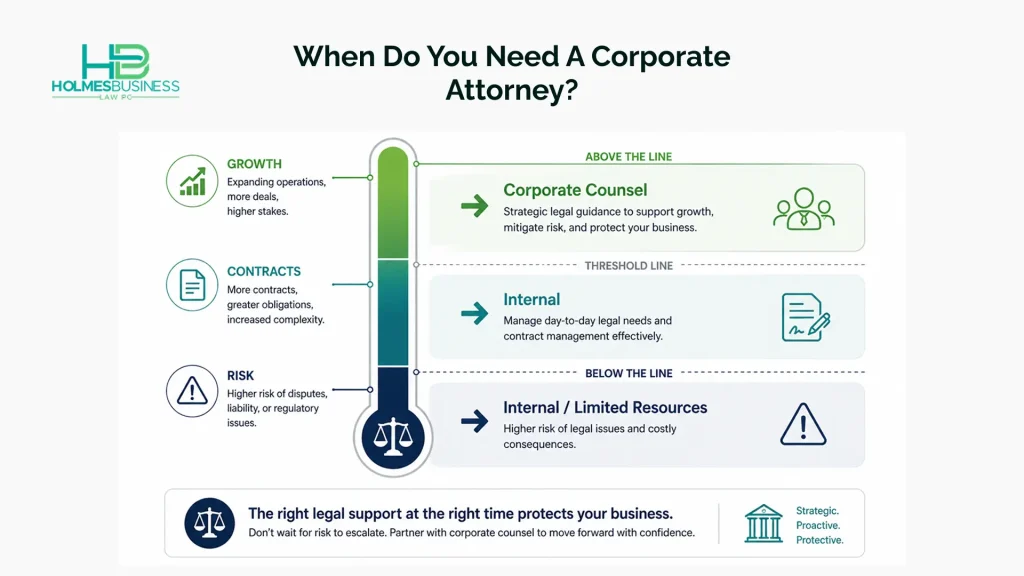
Selecting the perfect corporate attorney is the beginning. The most important matters are how this relationship is structured, the responsiveness of the support, and whether it scales with your business.
- Trust your transaction with skilled business purchase lawyers. It enables you to protect your investment, minimize risk, and close deals efficiently.
- We help employers draft, review, and negotiate clear, legally appropriate employment contracts and other agreements that protect businesses and minimize risk.
- The business contract lawyer helps you to draft, review, and negotiate. It offers a quick turnaround for time-sensitive agreements and guides clearly to business owners and teams.
- Most business owners need to lease commercial space, but there are often pitfalls and landmines. Unlike residential real estate, which is mandated by law, commercial property has a commercial lease agreement.
- As a small business owner, you should have an idea of the needs of copyright or trademark. If you are a photographer or online seller, you know about piracy. Therefore, we will help you determine when and how to register your creation with copyright or trademark.
- We will help you choose the business entity, such as an LLC, C-corp, B-corp, or limited partnership.
Holmes Business Law offers a structured and flexible approach that combines precision, scalability, and global accessibility to support businesses at several stages of growth.
FAQs
They assist with business formation, contracts, compliance, and legal strategy, all while ensuring the smooth operation of your company and lowering risk.
Expenditure varies based on experience and scope. Most are flexible with their payment structures, such as charging by the hour, on a retainer basis, or on a project basis.
The earlier stages of your business (hopefully). It is far more costly and risky to wait until problems occur.
While regional experts may better appreciate the local regime, expertise, and responsiveness are much greater than the location alone.
A corporate attorney specializes in business law, governance, contracts, and compliance, while a general lawyer may handle a broader range of legal issues.
By advising on contracts, compliance, mergers, and intellectual property protection, they ensure every decision aligns with long-term business goals. Their ongoing guidance helps small businesses scale confidently while minimizing legal and operational risks.
Conclusion
Choosing the perfect corporate attorney near me is not only about location but also about partnerships. The appropriate counsel will help you to prevent complexity, minimize risks, and unlock growth opportunities. A well-selected attorney is an asset, not a legal necessity. With the appropriate partner, businesses are in a better position.
Organizations like Holmes Business Law bring the partnership into focus through structured corporate and general counsel services that match your business objectives. If it is focused on governance decisions, supporting vital deals, or ensuring continuous compliance, the approach is intended to integrate legal strategy into daily business operations.
Key Takeaways:
- Choose a corporate attorney who understands your business, not just the law. The best legal partners go beyond compliance; they grasp your industry, operations, and growth goals, offering advice that’s both practical and strategic.
- Prioritize experience in governance, deals, and compliance. An attorney with proven expertise in these areas ensures your contracts, partnerships, and regulatory obligations are handled with precision and foresight.
- Look for proactive guidance, not just reactive support. Strong counsel anticipates challenges before they arise, helping you make informed decisions that prevent costly disputes and strengthen long-term resilience.
- Ensure clear communication and transparency. Open dialogue about fees, timelines, and expectations builds trust and allows you to focus on running your business while your attorney manages the legal complexities.
- Treat legal counsel as a long-term investment in your business success. A reliable corporate attorney becomes a strategic ally, protecting your interests, guiding growth, and ensuring every decision supports sustainable progress


