
Apparently, over 65% of commercial disputes arise from contract-related issues such as delayed payments or failure to perform. Your contract may look extremely straightforward. The pricing may also seem reasonable. Yet there are so many chances of disputes that may arise if you sign them without careful review.
If you are a business owner, even the smallest details in your contract can carry massive legal and financial consequences, and honestly, it can feel weirdly high stakes over stuff that looks minor. Small clauses such as payment terms, termination rights, liability, and other provisions can pose significant issues in your day-to-day operations.
That is why understanding the basics of contract law is so important, and teaming up with a solid business contract lawyer like Holmes Business Law. In this guide, we will walk you through a practical contract review checklist, point out some common red flags, and discuss how working with a business contract lawyer can help you avoid costly mistakes later on.
Table Of Contents
- Why Contract Review is Necessary?
- What Is The Ultimate Contract Review Checklist?
- What Are The Common Contract Red Flags?
- How Holmes Business Law Protects Your Business?
- Frequently Asked Questions
- Conclusion
- Key Takeaways
Why Contract Review Is Necessary?
Many business owners assume contracts are standard documents that cannot be changed. In reality, most agreements are negotiable.
A thorough review helps you:
- Understand your legal obligations.
- Identify hidden risks.
- Clarify payment expectations.
- Protect intellectual property.
- Prevent future disputes.
- Ensure compliance with applicable laws.
Even the simplest vendor agreements or service contracts can bring changes that may favor the other party. A careful review always gives you a better chance to negotiate fairer terms before the agreement becomes legally binding.
What Is The Ultimate Contract Review Checklist?
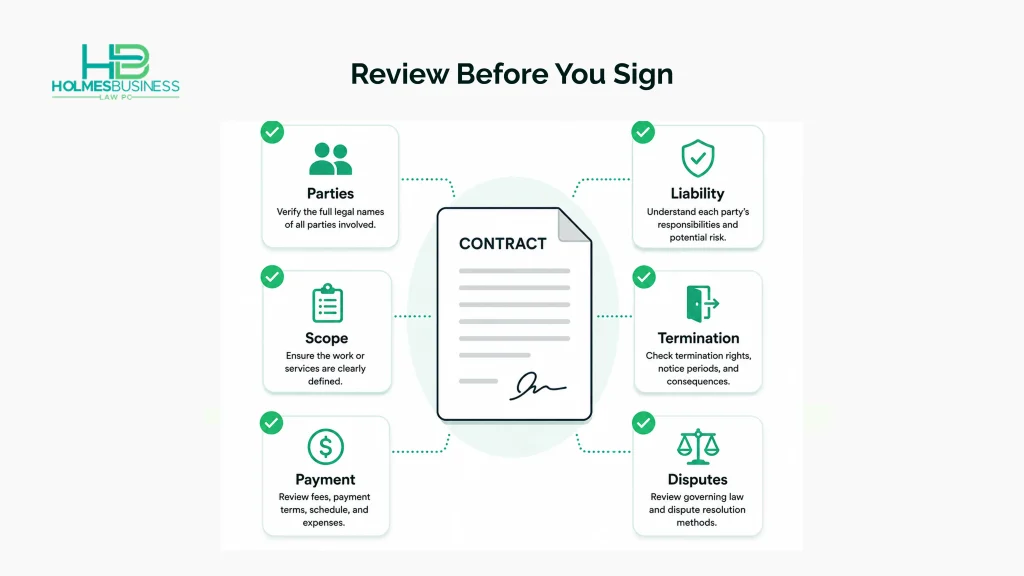
- Verify The Identity Of All Parties
Always confirm that the contract correctly identifies every party involved. Legal names, business entities, addresses, and contact information should be accurate throughout the document.
Never sign contracts with the wrong entity names, else this can create enforcement challenges later.
- Review The Scope Of Work Carefully
One of the most common causes of business disputes is an unclear scope of work.
Ask yourself:
- What exactly is being provided?
- Are deliverables clearly defined?
- Are milestones specified?
- Are deadlines included?
Avoid vague language such as “as needed” or “reasonable efforts” without any additional clarification.
- Examine Payment Terms
Payment clauses deserve special attention.
Review:
- Payment amounts
- Due dates
- Deposit requirements
- Late payment penalties
- Refund provisions
- Expense reimbursement terms
A contract should clearly explain when payments are due and what happens if either party fails to pay on time. Any vague language can give rise ot potential conflicts.
- Understand Contract Duration And Renewal Terms
Many business owners focus on the beginning of the agreement and overlook the end.
Check for:
- Contract start date
- Expiration date
- Renewal provisions
- Automatic renewal clauses
- Notice requirements
Auto-renewal clauses may lock your business into additional terms if your notice has no specific timeframe. This is often the most overlooked aspect of the contract.
- Review Termination Rights
Every contract should explain how either party can end the relationship.
Look for:
- Termination for convenience
- Termination for breach
- Notice requirements
- Cure periods
- Early termination penalties
A fair contract provides a reasonable exit strategy for both parties. Ensure that you do not sign the document that allows only one party to terminate the agreement without consequences. Negotiate here.
- Evaluate Liability Provisions
Liability clauses often contain the biggest legal risks.
Pay close attention to:
- Limitation of liability clauses
- Consequential damage exclusions
- Caps on damages
- Risk allocation provisions
This will help you hold the right person accountable if something goes wrong. Because even the most minor issue can bring massive financial liability to your business.
- Review Indemnification Clauses
Indemnification provisions require one party to compensate another for certain losses or claims.
Questions to consider include:
- Who is indemnifying whom?
- What claims are covered?
- Are there limitations?
- Is the obligation mutual?
One-sided indemnification clauses are a common concern for many small businesses. Thus, it should be reviewed carefully.
- Protect Confidential Information
If sensitive information is to be exchanged, confidentiality provisions are essential.
Review:
- Definition of confidential information
- Permitted disclosures
- Duration of confidentiality obligations
- Security requirements
Strong confidentiality language can help safeguard trade secrets, customer information, and proprietary business processes.
- Confirm Intellectual Property Ownership
Many business owners overlook intellectual property clauses until a dispute arises.
The contract should clearly answer:
- Who owns the work product?
- Who owns copyrights?
- Who owns trademarks?
- Who owns inventions or improvements?
Never assume ownership rights automatically transfer without written language stating so.
- Check Warranties And Representations
Warranties and representations establish promises made by each party.
These provisions often address:
- Product quality
- Legal compliance
- Authority to enter into the agreement
- Performance expectations
Review these statements carefully because they may create future obligations or liabilities.
- Understand Dispute Resolution Procedures
Even well-drafted contracts can lead to disagreements.
Review how disputes will be handled:
- Mediation requirements
- Arbitration provisions
- Litigation rights
- Venue selection
- Governing law
Knowing where and how disputes will be resolved can save significant time and expense later.
- Look For Compliance Requirements
Certain industries face unique regulatory obligations.
Depending on your business, contracts may need to address:
- Employment regulations
- Data privacy requirements
- Consumer protection laws
- Industry-specific compliance standards
Failure to comply with legal requirements can create liability even when both parties intend to follow the agreement.
- Search For Ambiguous Language
Ambiguous terms create uncertainty.
Watch for phrases such as:
- Reasonable efforts
- Best efforts
- Material breach
- Industry standard
- Timely manner
While these terms are common, they may require clarification depending on the context.
Clear language reduces the likelihood of future disputes.
- Check For Missing Information
Before signing, confirm there are no:
- Blank spaces
- Missing attachments
- Incomplete exhibits
- Undefined terms
- Contradictory provisions
Even small omissions can create significant legal issues later.
What Are The Common Contract Red Flags?

- One-Sided Obligations
If most obligations fall on your business while the other party assumes minimal responsibility, further negotiation may be necessary.
- Excessive Liability Exposure
Unlimited liability provisions can expose your business to significant financial risk.
- Unclear Deliverables
If the contract does not clearly define what is being provided, disputes become more likely.
- Restrictive Non-Compete Provisions
Some agreements contain restrictive provisions that may limit future business opportunities.
- Hidden Renewal Clauses
Automatic renewals often catch businesses by surprise when they fail to provide timely notice.
- Broad Indemnification Requirements
Extremely broad indemnification language may require you to assume risks that should belong to the other party.
How Holmes Business Law Helps Protect Your Business?

At Holmes Business Law, contract review is a core aspect that helps keep your company safe from future legal issues. Whenever you are starting a new venture, negotiating an agreement, or even hiring new employees, they give you the much-needed legal guidance that will prevent costly issues later.
The firm’s business law services include:
- Create, review, and negotiate business contracts that clearly define responsibilities, reduce legal risk, and protect your interests before you sign.
- Receive guidance on choosing and structuring the right business entity, whether you are forming an LLC, corporation, partnership, or another business structure.
- Navigate the legal complexities involved in buying or selling a business, including contract negotiations, due diligence, and transaction documentation.
- Review commercial lease agreements carefully to identify unfavorable terms, negotiate lease provisions, and protect your business from unnecessary obligations.
- Develop employment agreements, workplace policies, and hiring practices that support compliance while protecting your business interests.
- Safeguard your intellectual property through trademark, copyright, and brand protection strategies that help preserve the value of your business assets.
- Access practical legal guidance as your business grows, helping you address contracts, compliance concerns, disputes, and operational decisions before they become larger problems.
This way, your business can actively address any potential risks way early. This ultimately helps strengthen business relationships and focus more on long-term growth with greater confidence. Because you no longer have to worry about the legal landscape anymore.
FAQs
Contract review is there to spot legal, financial, and operational risks before an agreement gets locked in as legally binding. It also makes sure everyone sort of gets on the same page about their rights and duties, not just the wording.
Contract law gives the legal structure for business arrangements. It helps set out enforceable rights, responsibilities and, if things go sideways , the remedies that follow.
Yes. In most cases business contracts are negotiable in practice. You can often adjust terms about payment, liability, termination, and dispute resolution before anyone signs.
Start with who the parties are, then the scope of work, payment terms, contract duration, termination rights, and the liability provisions. Those pieces usually drive everything else.
An indemnification clause, basically decides whether one side must reimburse the other for certain losses, damages, or even legal claims that show up because of the agreement.
Templates can be a decent starting point, but they might not reflect your specific setup or comply with applicable laws. A professional look-over is usually wise, even if you use a template.
A lawyer should review contracts that involve major financial exposure, intellectual property, long-term commitments, regulatory issues, or complicated legal language that feels hard to predict.
Conclusion
Signing a contract is extremely crucial, especially when you are running a business. Every agreement creates so many legal obligations that can potentially affect your finances, operations,s and even future business relationships. This is why a structured review process is so important.
A business contract lawyer by Holmes Business Law actually helps you uncover any potential hidden risks, clarify expectations in the agreements, and even protect your interests before things escalate. Thus, whether you are reviewing a vendor agreement, a partnership contract, or simply a commercial lease, you always have someone to advise you on this point.
Key Takeaways
- Every standard agreement should be carefully reviewed. Even the tiniest provisions can bring significant financial and legal consequences.
- Focus more on risk allocation. These aspects have the greatest impact during disputes.
- Verify various business terms and legal terms. There should be no potential unnecessary risk in the future.
- Watch out for hidden traps like auto-renewal clauses, vague obligations, and others. Identifying them early gives you better leverage to negotiate.
- A professional business contract lawyer is the best way to uncover issues that may not be very obvious to business owners. Investing in contract review is a much better use of resources than resolving the dispute after signing.