
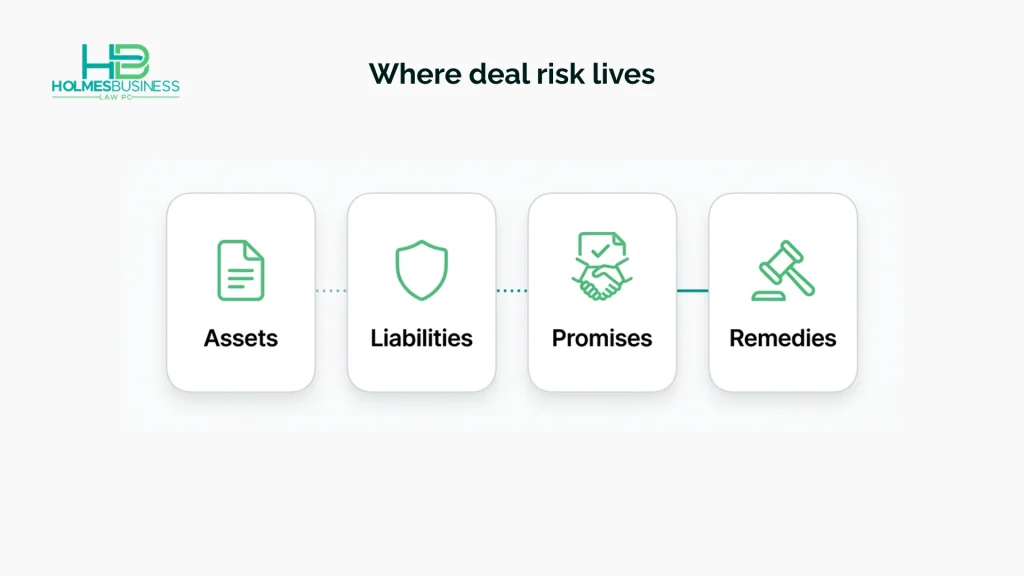
You signed a letter of intent, agreed on a price, and started planning for closing. The deal is still not finished. A business purchase agreement turns the LOI’s main terms into binding obligations and assigns risks the LOI usually leaves open.
Before signing, confirm exactly what you are buying, which liabilities you are assuming, what the seller is promising, how claims will be handled after closing, and whether liens, taxes, contracts, licenses, or financial discrepancies remain unresolved.
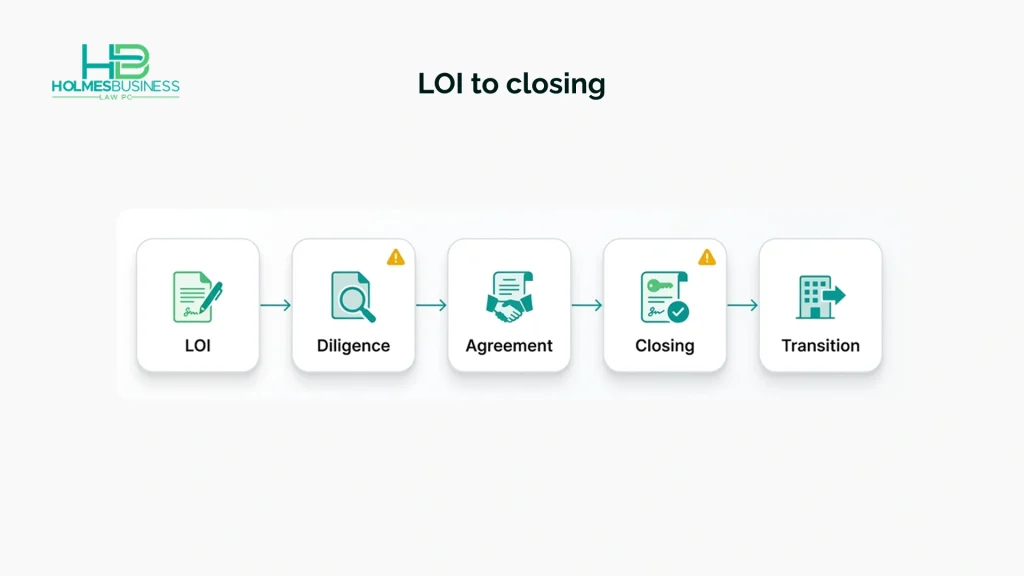
What Happens After You Sign the LOI?
After the LOI, broad deal terms must be tested against the records and converted into enforceable contract language. The purchase agreement should reflect what due diligence proves, not simply repeat the seller’s description of the business.
Is the LOI Legally Binding?
An LOI often says the proposed purchase remains nonbinding until the parties sign a final agreement. That does not mean every provision is nonbinding. Confidentiality, exclusivity, access to records, expenses, and governing-law provisions may be binding.
Read the actual language before taking action that could violate a continuing term. The title “letter of intent” does not decide what is binding. The wording does.
Can the Purchase Agreement Change the LOI Terms?
Yes. Due diligence may reveal facts that justify different terms. Lower revenue may support a lower price. A lien may require a payoff and release. A key contract may require consent. A license delay may require a later closing date.
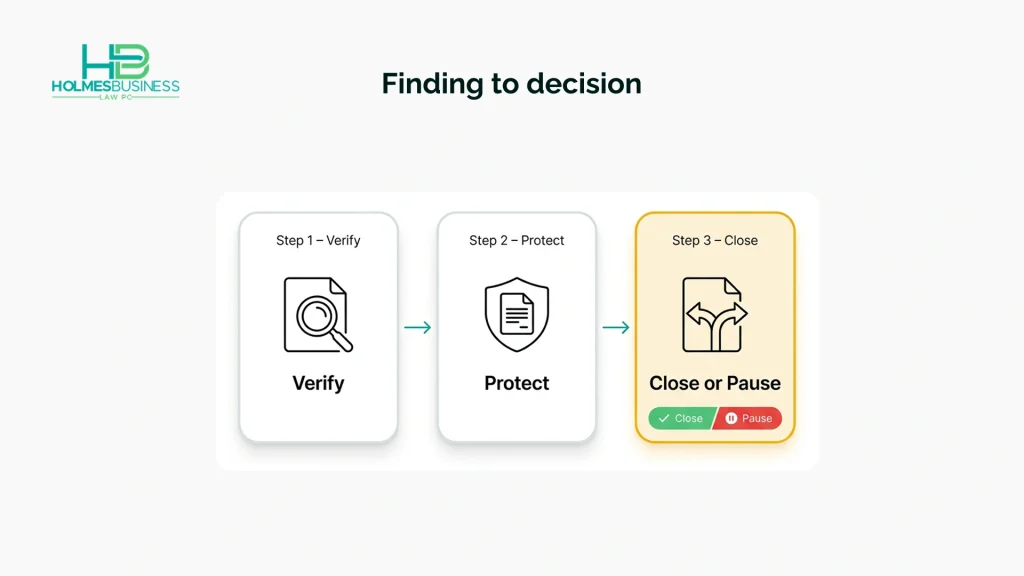
Use this framework for each important finding:
| Due-Diligence Finding | Contract Response | Closing Decision |
| Explained and immaterial | Document the explanation | Continue |
| Changes value or risk | Adjust price or add protection | Continue with revised terms |
| Must be fixed first | Make it a closing condition | Delay |
| Prevents lawful or practical operation | Exercise an available termination right | Do not close |
Diligence should change a decision, a document, or both. It should not merely produce a larger file.
Should You Use an Asset Purchase Agreement or an Equity Purchase Agreement?
The structure determines what transfers and which risks remain attached to the business. Most small-business purchases are structured as a purchase of selected assets or a purchase of the seller entity’s ownership interests.
What Does an Asset Purchase Agreement Cover?
In an asset purchase, the buyer acquires specified assets. These may include equipment, inventory, goodwill, trade names, websites, telephone numbers, customer lists, intellectual property, and transferable contracts.
The agreement should also identify excluded assets, such as the seller’s cash, tax refunds, personal property, or accounts receivable.
An asset purchase may help limit assumed obligations, but it does not make risk disappear. The agreement must define assumed and excluded liabilities carefully. Some claims can still affect the buyer or the acquired operation under applicable law.
What Changes in an Equity Purchase?
In an equity purchase, the buyer acquires stock in a corporation or membership interests in an LLC. The entity usually keeps its assets, contracts, and historical obligations.
That continuity can help preserve some relationships, but it can also leave old liabilities inside the company. Financial, tax, employment, litigation, and regulatory diligence become especially important.
Why the Schedules Matter
The main agreement sets the rules. Its schedules supply the deal-specific facts. Detailed schedules can identify each vehicle, machine, domain name, customer contract, item of intellectual property, and assumed obligation.
If an asset is essential to day-one operations, name it or place it in a clearly defined category. Confirm that the schedules are updated before signing and again before closing.
Which Business Purchase Agreement Clauses Matter Most?
The most important clauses define what you receive, what you pay, which risks you accept, and what happens if a seller’s statement is wrong.
Purchased and Excluded Assets
The purchased-assets section should match the operation you expect to take over. Review equipment, inventory, contracts, customer information, intellectual property, websites, social-media accounts, deposits, and records.
Ask who legally owns each asset. A machine may be leased. A domain may be registered to an employee. A trademark may belong to the owner personally instead of the selling entity.
Excluded assets also need precision. If the seller keeps receivables, vehicles, or intellectual property, the exclusion should not prevent you from operating the business.
Assumed and Excluded Liabilities
An assumed-liabilities clause should identify the obligations you accept. These may include selected contract duties arising after closing, customer deposits, gift cards, equipment leases, or listed accounts payable.
Excluded liabilities may include pre-closing taxes, employee compensation, debt, lawsuits, broker fees, warranty claims, and contract breaches occurring before closing.
Do not assume that “no liabilities are assumed” resolves every issue. The agreement should address obligations tied to customers, employees, assets, and continuing contracts.
Purchase Price and Adjustments
The agreement should explain the full payment structure, including any deposit, closing payment, seller financing, earnout, escrow, or holdback.
It should also explain how the final amount will be calculated. Inventory may be counted. Rent and recurring expenses may be prorated. Some deals use a working-capital target so the business transfers with enough current assets for ordinary operations.
Purchase-price allocation matters in an asset acquisition. The IRS states that seller and purchaser must use Form 8594 for a qualifying sale of a group of business assets when the stated conditions apply. The parties should involve their tax advisers and require consistent reporting.
Price should also be tested against verified earnings and operational risk. Holmes Business Law’s valuation guide explains how cash flow, risk, and transferability affect what a business may be worth to a buyer.
Representations and Warranties
Representations and warranties are factual promises in the agreement. They give the buyer a contractual remedy if an important statement proves false.
A seller may promise that it owns the assets, has authority to sell, supplied accurate financial information, filed required taxes, disclosed litigation, provided complete contracts, identified employees, and disclosed liens.
The right promises depend on the business and the diligence findings. A restaurant, construction company, professional practice, and online retailer do not carry the same risks.
Disclosure Schedules
Disclosure schedules provide deal facts and exceptions to the seller’s promises. They are not routine attachments.
The agreement may say there is no litigation except for matters on a schedule, or that assets are lien-free except for listed security interests. Those disclosures change the practical meaning of the main text.
Compare each schedule to the section it modifies. A late or material disclosure may require more diligence time, a revised term, or a special remedy.
Conditions to Closing
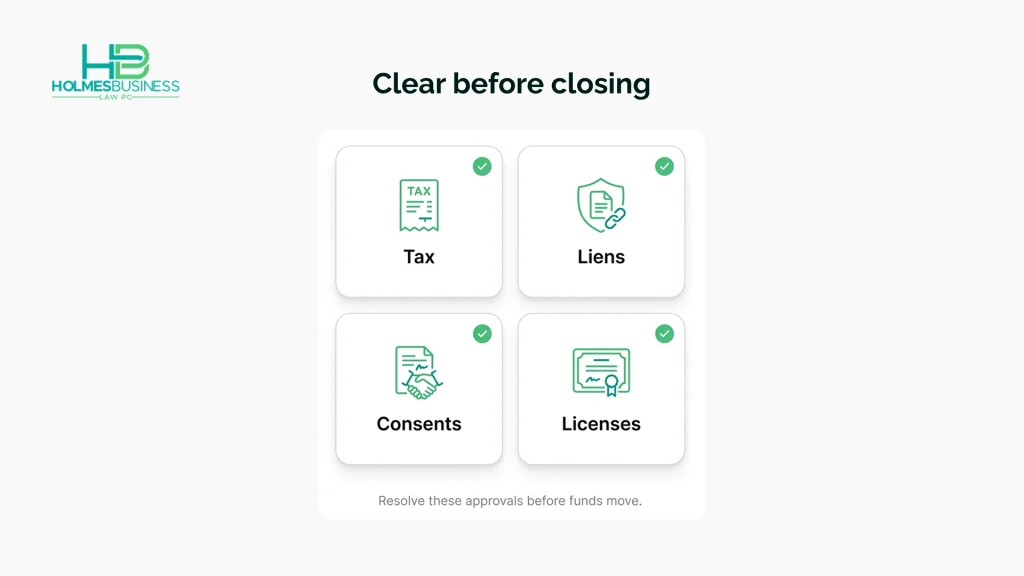
A closing condition is an item that must be satisfied before a party must close. It is often more useful than relying on a damages claim later.
Buyer conditions may include landlord consent, assignment of key contracts, tax clearances, lien releases, license approval, lender approval, and continued accuracy of the seller’s promises.
Use specific deliverables and deadlines. Vague language can create a dispute about whether the condition was met.
Indemnification, Escrow, and Holdbacks
Indemnification requires the seller to reimburse the buyer for covered losses. The agreement should state which claims are covered, how long protection lasts, how notice works, and how disputes are handled.
A basket sets the amount of losses required before a claim can be made. A cap limits maximum exposure for specified claims. An escrow places money with a neutral holder. A holdback lets the buyer retain part of the price temporarily. A setoff right may allow later payments to be reduced by a valid claim.
Known tax, ownership, employee, or litigation issues may need separate protection instead of treatment under the general cap.
Restrictive Covenants and Transition Assistance
A buyer may need training, customer introductions, records, passwords, and reasonable post-closing help. State the hours, time period, method of support, and whether extra work is paid.
Confidentiality, nonsolicitation, and noncompetition provisions may protect acquired goodwill. Their duration, territory, and scope should fit the actual business and the interests purchased.
Which Documents Should You Review?
A strong business purchase agreement depends on diligence that connects each seller promise to records that confirm or challenge it.
Formation and Ownership Records
Review formation documents, governing documents, ownership records, amendments, fictitious-name filings, and approvals authorizing the sale. Confirm the correct legal name of the seller and everyone who must sign.
Pennsylvania’s Business Filing Services allows users to find and purchase existing business and UCC records. Use those records to confirm status and filing history, but compare them with the seller’s own governing documents and approvals.
Financial and Tax Records
Ask for tax returns, profit-and-loss statements, balance sheets, bank statements, general ledgers, receivables and payables aging, sales reports, payroll records, and sales-tax records.
Compare them. Do reported revenue and deposits tell the same story? Are add-backs documented? Are customer deposits recorded as liabilities? Does the business need more working capital than expected?
An explainable difference may need written clarification. A material difference may require a lower price, earnout, holdback, or decision to stop.
Contracts, Real Estate, and Employment Records
Review the lease and all amendments, plus customer, vendor, equipment, franchise, software, and financing agreements. Focus on assignment restrictions, change-of-control clauses, termination rights, defaults, renewal dates, and personal guarantees.
Review the employee roster, compensation, benefits, accrued leave, bonuses, commissions, contractor agreements, restrictive covenants, wage claims, and agency correspondence.
Identify the workers you plan to hire, what the seller must pay through closing, and which contracts need consent. A valuable contract that cannot transfer may change the deal.
Assets, Liens, and Intellectual Property
Request equipment lists, invoices, titles, inventory records, loan documents, payoff statements, intellectual-property registrations, domain records, software licenses, and account-control information.
A UCC search can reveal financing statements covering personal property. Pennsylvania currently lists a $12 search fee per debtor name, plus copy or certification charges. Debtor names are indexed as they appear on the financing statement, so name accuracy matters.
Investigate relevant filings, obtain current payoff letters, and require appropriate release or termination documents at closing.
Clause-to-Document Verification Table
| Seller’s Promise | Documents to Review | Possible Contract Response |
| Seller owns equipment | Invoices, titles, leases | Ownership promise and bill of sale |
| Assets are lien-free | UCC searches, loan records, payoff letters | Release as a closing condition |
| Financial information is accurate | Tax returns, bank records, ledger | Financial promise and price adjustment |
| Contracts will continue | Contracts, amendments, consent terms | Written consent before closing |
| Intellectual property transfers | Registrations, assignments, domain records | Specific transfer documents |
| Licenses will be available | Licenses, applications, agency letters | Approval as a closing condition |
Which Pennsylvania Issues Require Special Attention?
Pennsylvania buyers should address state tax clearance, liens, and licensing early enough to affect the closing schedule.
Bulk-Sale Tax Clearance
Pennsylvania’s Department of Revenue states that the bulk-sale law applies when taxpayers transfer more than 51 percent of assets, including real property or asset classes such as machinery and equipment. It says purchasers must secure bulk-sale clearance certificates from sellers to avoid unknowingly becoming liable for the seller’s Pennsylvania tax liabilities.
The Office of Unemployment Compensation Tax Services states that an entity selling 51 percent or more of its assets must give L&I ten days’ written notice. It identifies REV-181 as the application for bulk-sale clearance and directs applicants to send the original to Revenue and a copy to L&I.
The agreement should assign responsibility for the application, cooperation, certificates, pre-closing taxes, and any escrow needed while clearance is pending.
UCC Searches and Lien Releases
Use the seller’s exact legal name. Review active filings, identify the debt and collateral, obtain payoff letters, and confirm what the secured party will file or deliver after payment.
Pennsylvania currently lists an $84 fee for a UCC financing statement or amendment and a $12 search fee per debtor name. Confirm current fees before filing.
Licenses and Permits
Do not assume a license transfers with the assets. Identify the regulator, application, inspection, approval, and lead time before fixing the closing date.
Pennsylvania says retail food licenses are nontransferable to another proprietor, facility, or location. New owners must submit a change-of-ownership application. The state page generally calls for materials at least 60 days before food preparation or sales and notes that Philadelphia and several counties use their own jurisdictional processes.
For liquor-licensed businesses, the Pennsylvania Liquor Control Board uses person-to-person transfers for ownership changes, along with place-to-place and double transfers in other circumstances.
What Red Flags Should Make You Pause?
A red flag should change your next step. It may require more records, a revised price, stronger protection, a delayed closing, or a decision to walk away.
| Finding | Initial Response | Stronger Protection | Possible Walk-Away Issue |
| Financials do not match tax returns | Request a reconciliation | Price adjustment and targeted promise | Material differences remain unexplained |
| UCC lien covers key equipment | Obtain debt and payoff records | Release before closing | Clear title cannot be delivered |
| Major contract requires consent | Contact the other party | Consent as a closing condition | Essential consent is denied |
| Seller delays records | Set a deadline | Extend diligence and exclusivity | Records remain incomplete |
| Undisclosed tax balance appears | Quantify exposure | Clearance, escrow, special indemnity | Exposure remains material |
| Required license will not be ready | Confirm process | Delay or restructure | Business cannot lawfully operate |
Other warning signs include unexplained cash sales, personal expenses mixed with business expenses, dependence on one customer, missing contract amendments, seller-owned intellectual property, unpaid employee amounts, unrecorded customer deposits, and equipment owned by someone else.
Pressure to sign before schedules are complete or close before lien and license issues are resolved should also prompt a direct risk discussion.
Not every problem ends a deal. A known problem can often be priced and documented. The dangerous problem is one that remains uncertain while you are being asked to close.
What Is Signed at Closing?
Closing documents transfer assets, complete payment, release old claims, and establish continuing duties. The exact set depends on the deal.
Transfer Documents
Common documents include a bill of sale, assignment and assumption agreement, intellectual-property assignments, title documents, contract assignments, third-party consents, and a lease assignment or new lease.
Asset descriptions should remain consistent across the purchase agreement, bill of sale, and financing documents. Confirm that serial numbers, vehicle identification numbers, account names, and intellectual-property details match before funds are released.
Payment and Security Documents
Payment documents may include a settlement statement, promissory note, escrow agreement, security agreement, personal guaranty, and UCC financing statement.
Seller-financing documents should address payment dates, interest, default remedies, collateral, bank-lender priority, and any setoff right. They should also state when the seller may accelerate the balance and what notice or cure period applies after a default.
Corporate and Compliance Documents
The closing set may also include resolutions, officer certificates, tax forms, bulk-sale materials, license approvals, payoff letters, lien releases, restrictive covenants, and transition agreements.
Not every transaction uses every document. Build the list from the agreement, financing, diligence findings, assets, contracts, and regulatory requirements. The purchase agreement should identify each required deliverable and who must provide it.
What Should You Confirm Before Closing?
Before releasing funds, confirm that the documents and business reality match the deal you intended to buy.
- The agreement matches the negotiated terms.
- Included and excluded assets are scheduled.
- Assumed and excluded liabilities are scheduled.
- Disclosure schedules are complete.
- Financial differences are resolved.
- Required consents are signed.
- Licenses and approvals are effective or properly addressed.
- Pennsylvania bulk-sale requirements are handled.
- Payoff letters and lien releases are ready.
- Inventory, working capital, and prorations are confirmed.
- Seller-financing and escrow documents are final.
- Transition duties are specific.
- Post-closing claim procedures are workable.
- Every closing deliverable is final.
Your lawyer should document the transaction and explain the legal tradeoffs. Your accountant or tax adviser should review financial quality, tax treatment, and purchase-price allocation. Regulators, landlords, lenders, and contract counterparties may control approvals neither buyer nor seller can guarantee.
Holmes Business Law assists Pennsylvania buyers with due diligence, negotiations, purchase agreements, and deal documents.
Frequently Asked Questions
No. An LOI usually records proposed terms and the process for reaching a final agreement. The purchase agreement contains the binding purchase terms, risk allocation, closing conditions, and remedies. Check the LOI because confidentiality, exclusivity, and similar provisions may already be binding. The final agreement should also state whether it replaces earlier discussions and documents.
Often, yes, when the purchase remains subject to diligence and a definitive agreement. Verified facts may support a different price, structure, protection, or closing date. Your rights depend on the LOI’s wording, deadlines, and any binding provisions. Review the document before threatening to terminate or contacting another seller. The correct response depends on the rights the parties actually preserved.
An asset purchase transfers specified assets and identified liabilities. An equity purchase transfers ownership of the existing corporation or LLC, which usually continues to hold its assets and obligations. Taxes, contracts, licenses, financing, and liability exposure affect the choice. Ask legal and tax advisers to evaluate the same proposed structure.
No structure eliminates every risk. An asset purchase lets the agreement define assumed liabilities, but liens, taxes, employee claims, contracts, regulatory rules, and successor-liability principles may still matter. Careful drafting must be paired with legal, financial, and tax diligence. The closing documents must also transfer the assets and release existing claims correctly.
They are factual promises in the purchase agreement. A seller may promise that it owns the assets, disclosed litigation, supplied accurate records, and identified liens. If a promise is false, the indemnification and remedy terms control the buyer’s claim. The disclosure schedules may qualify those promises, so read both together.
A disclosure schedule lists deal facts and exceptions to statements in the agreement. It may identify contracts, employees, liens, litigation, permits, or intellectual property. Read each schedule with the section it modifies because an exception can materially reduce the apparent protection. Request enough time to investigate material disclosures before signing.
There is no universal period. Timing depends on business size, record quality, financing, leases, contracts, licenses, and seller responsiveness. The deadline should allow time to receive records, review them, and follow up on material questions. Extend the period when important information arrives late or remains incomplete. A rushed review transfers uncertainty to the buyer.
A UCC search is commonly used to identify financing statements that may cover the seller’s personal property. It does not replace title, tax-lien, judgment, lease, or other searches. Investigate each relevant filing and obtain payoff and release documents. Pennsylvania’s current fee is $12 per debtor name. Confirm the fee again before ordering.
Sometimes, but many licenses require a transfer application, new application, inspection, or approval. Pennsylvania retail food licenses are nontransferable between proprietors, and liquor-license ownership changes use the PLCB transfer process. Confirm the responsible regulator, application, and approval timeline before setting the closing date. Make required approval a closing condition when appropriate.
Decide whether it affects value, lawful operation, asset ownership, or a closing condition. Then request more records, revise the agreement, change the price, require escrow, delay closing, or use an available termination right. Document any resolution in the final agreement or closing papers. Do not release funds with a material issue unresolved.
Key Takeaways
- The LOI is the starting point. The purchase agreement provides detailed protection.
- Define purchased assets, excluded assets, assumed liabilities, and excluded liabilities precisely.
- Match seller promises to records that verify them.
- Use closing conditions for issues that must be resolved before ownership changes.
- Address Pennsylvania tax clearance, UCC liens, and licenses early.
- Treat unexplained financial differences, missing consents, unresolved liens, and delayed records as decision points.
- Make indemnification, escrow, holdbacks, and seller financing work together.
- Do not close until required documents, approvals, releases, and schedules are final.
A business purchase is safest when the records, contract, and closing deliverables tell the same story. Resolve any material difference before taking ownership.