
If you are entering a new business partnership, one of the first real tests of the relationship will be this simple question: how are we going to split the money?
It feels easier to postpone that conversation until the business is profitable. In reality, waiting is what leads to hurt feelings, “phantom income” surprises, and, eventually, partnership disputes. The most successful partnerships decide how profits, losses, and distributions will work before the money hits the bank account, and they bake those rules into a strong partnership or operating agreement.
This guide walks through how partner profit distribution really works, common methods for splitting profits, and the legal and tax issues that business owners in Pennsylvania and New Jersey should understand before signing.
Table Of Contents
- Why Profit Distribution Matters More Than You Think
- Understanding Profit Sharing, Allocations, And Distributions
- How Are Profits And Losses Distributed In A Partnership
- Common Partnership Profit Distribution Methods
- Step-By-Step: How To Decide Your Partnership Profit Sharing Formula
- Examples Of Distribution Of Profit And Losses In Partnerships
- Legal And Tax Considerations For Partner Profit Distribution
- Documenting Your Partnership Or LLC Profit Distribution Agreement
- When To Revisit Your Profit Sharing Arrangement
- How A Business Lawyer Helps Prevent Partnership Disputes
- FAQs About Partnership Profit Sharing And Distributions
- Conclusion

Why Profit Distribution Matters More Than You Think
Profit distribution is not just an accounting exercise. It drives:
- How motivated each partner feels to contribute.
- Whether partners feel fairly treated when cash is tight.
- How the IRS and state tax authorities view your income.
- How investors, lenders, or future buyers evaluate your business.
Many state laws and partnership acts assume that, in the absence of an agreement, partners share profits and losses equally. That might sound fair at first, but equal shares rarely match reality when one partner invests more money, works more hours, or takes on more risk.
A clear, written profit-sharing structure:
- Reduces the risk of stalemates in 50-50 partnerships.
- Clarifies who carries which risks and debts.
- Prevents surprises when tax time arrives.
For many small businesses, the “partnership” is actually a multi-member LLC taxed as a partnership. In those cases, the same profit allocation and distribution concepts still apply, but the details live in an operating agreement rather than a traditional partnership agreement.
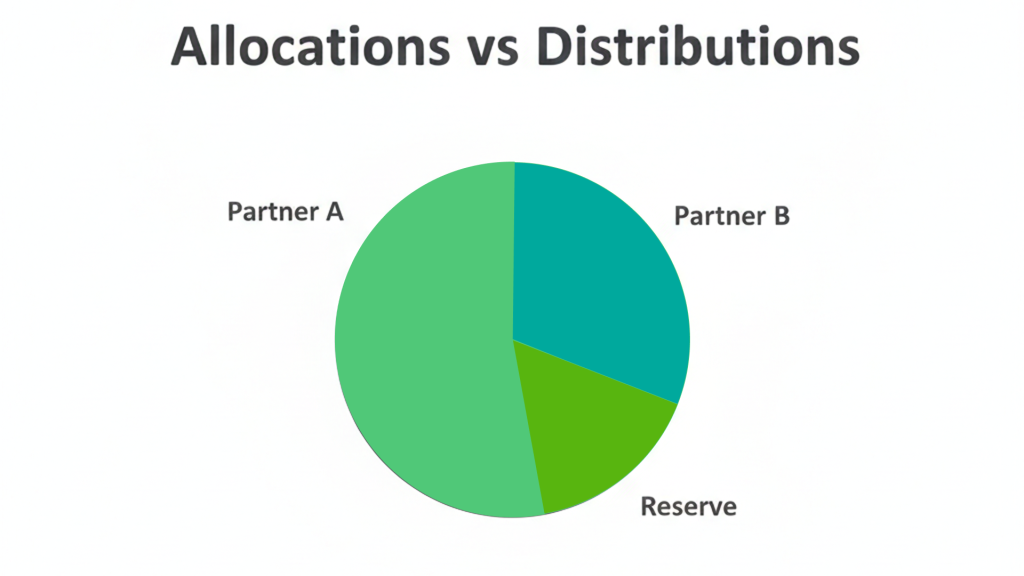
Understanding Profit Sharing, Allocations, And Distributions
Business owners often use profit sharing, allocations, and distributions as if they mean the same thing. They are related, but they are not identical.
- Profit sharing or profit allocation:
How profits and losses are assigned to each partner on paper. This shows up in the books, on the partnership’s tax return, and on each partner’s Schedule K-1. - Distributions:
When and how cash actually leaves the business and is paid out to partners. - Guaranteed payments (for some partnerships and LLCs):
Payments to a partner for services or the use of capital are made regardless of whether the partnership is profitable. For tax purposes, the IRS treats these more like a salary and requires them to be reported as ordinary income.
A partnership can allocate profits to a partner for the year without making a matching cash distribution. That is where “phantom income” appears: a partner has taxable income on paper but no cash in hand to pay the tax bill.
This is why it is so important to decide, up front, both:
- How profits and losses will be allocated.
- How and when cash distributions will be made to cover those tax liabilities and provide actual payouts.
How Are Profits And Losses Distributed In A Partnership
By default, if partners have not agreed otherwise in writing, many legal frameworks assume:
- Profits and losses are shared equally.
- Each partner has an equal say in management decisions.
In practice, equal distribution often does not reflect partners’ contributions. Instead, profit and loss distributions usually consider:
- Capital contributions.
- Whether a partner is a general partner with unlimited liability or a limited partner with capped liability.
- Roles and responsibilities in running the business.
- Time and effort contributed by each partner.
- Intellectual property, relationships, or other non-cash assets brought to the business.
Within a carefully drafted partnership or operating agreement, partners have considerable flexibility. They can decide on almost any profit-and-loss ratio they want, as long as everyone agrees and the terms are written clearly enough to administer and enforce.
Common Partnership Profit Distribution Methods
Business partnership profit sharing can take many forms. Here are some of the most common partnership profit distribution methods used by small businesses.
Equal Share Formula
Partners split profits and losses equally. For example:
- Two partners: 50% and 50%.
- Three partners: one third each.
This approach is simple and may work when contributions and responsibilities are genuinely equal. However, it can feel unfair over time if one partner invests more money, takes more risk, or carries the day-to-day workload.
Ownership Percentage Formula
Profits and losses are divided according to ownership percentages stated in the agreement. If Partner A owns 60 percent and Partner B owns 40 percent, they share profits and losses in that same ratio.
This method works well when:
- Capital contributions are clearly defined.
- Ownership percentages match decision-making authority.
Capital Contribution Or Capital Account Formula
Partners divide profits and losses based on the balance of their capital accounts. For example, at year’s end:
- Partner A’s capital account: 200,000 dollars
- Partner B’s capital account: 100,000 dollars
Profits and losses would be shared two-thirds to Partner A and one-third to Partner B.
Performance Or Role Based Split
Some partnerships layer in performance or role-based factors, rewarding:
- The partner who brings industry expertise or key licenses.
- The partner who runs day to day operations.
- The partner who generates the majority of sales.
Here, a partner may receive a higher share of profits than their capital contribution alone would justify.
Hybrid Structures
Most real-world partnerships combine several elements:
- Reasonable salaries or guaranteed payments for work.
- A base profit split tied to ownership or capital.
- Performance bonuses or incentive pools for sales or growth milestones.
There is no single correct formula. What matters is that the structure fits your specific partnership and can be administered cleanly.

Step By Step: How To Decide Your Partnership Profit Sharing Formula
If you are wondering how to distribute profits in a partnership or how to split profits in a small business partnership, use this practical framework.
Step 1: List Every Partner And Their Contributions
Include:
- Cash and property contributions.
- Time and operational responsibilities.
- Licenses, certifications, or industry experience.
- Lists, relationships, or intellectual property they are bringing.
Be honest about what each partner is really putting on the line.
Step 2: Decide Who Bears Which Risks
Consider:
- Who signs personal guarantees on leases or loans?
- Who is exposed to professional or personal liability?
- Whether some partners are limited partners or more passive members.
Partners who carry more risk often receive a larger share of profits.
Step 3: Choose A Baseline Profit And Loss Ratio
Ask yourselves:
- Do you want equal partners or a clear managing partner with a slightly larger share?
- Should profit and loss ratios track ownership percentages exactly, or should they be adjusted for sweat equity?
This is where you answer common questions like:
- Do partnership distributions have to be equal?
No, they do not, as long as the agreement is clear and all partners consent.
Step 4: Decide On Compensation Before Profits
Before you split profits, decide:
- Will any partners receive a salary or guaranteed payment for their services?
- Are there minimum payment expectations for managing partners?
- How you will handle health insurance premiums or similar benefits, which are often treated as guaranteed payments for tax purposes.
These items are typically deducted before you divide remaining profits.
Step 5: Set Rules For Cash Distributions
Written rules should answer:
- When will cash distributions be made?
- How much cash will be held back for taxes, reserves, and future investments?
- How cash will be distributed if profits are allocated but cash flow is tight.
This is where you protect partners from large tax bills on income they have not actually received.
Step 6: Build “What If” Scenarios Into The Agreement
Your partnership or LLC profit distribution agreement should include what happens if:
- A new partner joins.
- A partner leaves, retires, or passes away.
- The business is sold, or a buyout occurs.
- A partner stops contributing at the same level.
These provisions are just as important as the starting percentages.
Examples Of Distribution Of Profit And Losses In Partnerships
Here are a few simplified examples to show how profit sharing between partners can work in practice.
Example 1: Equal Capital, Unequal Effort
- Partner A: contributes 100,000 dollars and manages daily operations.
- Partner B: contributes 100,000 dollars and is a passive investor.
The partners agree:
- Losses will be split 50/50.
- Profits will be split 80 percent to Partner A and 20 percent to Partner B.
If the partnership earns 200,000 dollars in profit:
- Partner A receives 160,000 dollars.
- Partner B receives 40,000 dollars.
This reflects the fact that Partner A carries more operational responsibility.
Example 2: Unequal Capital, Equal Involvement
- Partner A contributes 200,000 dollars.
- Partner B contributes 100,000 dollars.
- Both partners work full-time in the business.
The partners decide:
- Profits and losses will be shared based on capital account balances at year-end.
If net profit is 150,000 dollars:
- Partner A receives 100,000 dollars (two-thirds).
- Partner B receives 50,000 dollars (one-third).
Example 3: Hybrid With Guaranteed Payments
- Partner A: managing partner, runs operations full-time.
- Partner B: passive investor.
They agree:
- Partner A receives a guaranteed annual management payment of $80,000.
- Remaining profits are split 60 percent to Partner B and 40 percent to Partner A, based on capital contributions.
If net income before the guaranteed payment is 200,000 dollars:
- The business deducts 80,000 dollars as a guaranteed payment to Partner A.
- The remaining 120,000 dollars is split:
- 72,000 dollars to Partner B (60 percent).
- 48,000 dollars to Partner A (40 percent).
- Partner A’s total income from the partnership is 128,000 dollars.
This structure rewards both capital and day-to-day work.
These are just examples. Your partnership profit distribution methods should be tailored to your business, and the numbers should be tested with your accountant and attorney before they are included in a signed agreement.
Legal And Tax Considerations For Partner Profit Distribution
Profit-sharing decisions have real legal and tax consequences.
Pass Through Taxation
Most partnerships and many multi-member LLCs are taxed as pass-through entities.
- The business files a partnership return (Form 1065) but does not pay income tax itself.
- Profits and losses are allocated to partners and reported on their individual returns, whether or not they actually received cash distributions.
This is why the gap between allocations and distributions must be managed carefully.
Guaranteed Payments Versus Distributions
- Guaranteed payments to partners are treated as ordinary income to the partners and are deductible by the partnership if they qualify.
- Profit distributions are generally not deductible by the partnership and may be eligible for different tax benefits depending on the structure and current law.
Structuring these correctly requires coordination between legal and tax advisors, especially for professional service firms and high earners.
State Law And Default Rules
If your partnership or LLC does not have a strong written agreement, state default rules will fill in the gaps. In many cases, that means:
- Equal profit and loss sharing by default.
- Equal voting rights and no clear tie breaker.
Those defaults often do not match what the partners actually intended, which is why having a customized agreement matters.
Documenting Your Partnership Or LLC Profit Distribution Agreement
Whatever you decide, it only protects you if it is written clearly.
For a traditional partnership, the rules are usually set out in a partnership agreement. For an LLC taxed as a partnership, they live in an operating agreement. Banks and other lenders often will not even open a business bank account for a multi-member LLC without a formal operating agreement. You can check our Partnership Playbook for more information and clarity.
Your agreement should spell out, at a minimum:
- Each partner’s capital contributions and ownership percentage.
- Whether any partners receive salaries or guaranteed payments, and how those amounts are set.
- The profit and loss allocation percentages.
- The rules for distributions, including timing, tax distributions, and reserves.
- What happens if partners disagree, leave, join, or want to sell?
When To Revisit Your Profit Sharing Arrangement
Even the best profit distribution plan will not stay perfect forever. You should revisit your agreement if:
- A partner’s role or workload changes significantly.
- New partners or investors are coming in.
- The business has scaled up in revenue or risk.
- Partners are feeling tension about fairness, even if no one has raised it formally yet.
A good rule of thumb is to review partnership and operating agreements at least once a year with your advisors. Periodic check-ins are much cheaper and less disruptive than a full-blown partnership dispute or dissolution.
How A Business Lawyer Helps Prevent Partnership Disputes
A qualified business attorney does more than draft a template agreement.
With a firm like Holmes Business Law, you can expect help with:
- Walking through realistic best-case and worst-case scenarios for your partnership.
- Stress test your profit-sharing and distribution plan against those scenarios.
- Making sure your agreement aligns ownership, voting rights, and economic benefits.
- Coordinating with your tax advisor so allocations, guaranteed payments, and distributions all work together.
- Updating agreements when your business structure, team, or risk profile changes.
If you are already in a partnership and the current profit-sharing arrangement is causing tension, a lawyer can also help you renegotiate terms, document changes, or, if necessary, unwind the relationship with as little damage as possible.
FAQs About Partnership Profit Sharing And Distributions
It depends on how the entity is taxed. If the entity is taxed as a partnership, distributions need not be equal, nor do profit and loss allocations. If the entity is taxed as an S corporation, different rules apply. Partners are generally free to choose any arrangement they agree to, as long as it is documented clearly and administered consistently. State default rules often assume equal sharing only when there is no agreement in place. You must consult your CPA for tax consequences.
Start by:
Listing each partner’s capital, time, and responsibilities.
Deciding who bears which risks.
Choosing a base profit and loss ratio that reflects those contributions.
Setting any guaranteed payments or salaries first.
Putting the entire arrangement in a written partnership or operating agreement.
Because every business is different, it is wise to talk with both a business attorney and a tax professional before finalizing the numbers.
Economically, partnerships and multi-member LLCs taxed as partnerships work very similarly:
Profits and losses pass through to the owners.
The agreement controls how those profits and losses are allocated and how cash is distributed.
The main difference is the legal structure and the document that controls everything: a partnership agreement for a traditional partnership, and an operating agreement for an LLC.
In most cases, an “LLC profit distribution agreement” refers to the portion of your operating agreement that sets out:
Each member’s ownership interest.
How the LLC will allocate profits and losses.
When and how cash distributions will be made.
Banks, investors, and potential buyers will often ask to see this when evaluating your business, so it should be carefully drafted.
There is no universal “fair” percentage. A reasonable partnership profit-sharing percentage usually:
Reflects capital contributions.
Rewards partners who assume greater operational responsibility or liability.
Matches, or at least makes sense next to, ownership, and voting rights.
What matters most is that the partners understand the logic, feel it is fair, and sign a clear written agreement.
Conclusion
Profit sharing for business partnerships is not a one-page afterthought. It is a central part of how your business will function, how partners will be compensated, and how tax and legal risk will be shared.
When you decide in advance how to handle partner profit allocation, distributions, and profit or loss splits, you give your partnership a much better chance to succeed. When you leave those decisions to default rules or verbal understandings, you invite confusion and conflict.
A customized, well-drafted partnership or LLC operating agreement can:
- Align contributions, risks, and rewards.
- Reduce the odds of expensive disputes.
- Protect the business you are working so hard to build.
If you are forming a new partnership, revisiting an old one, or seeing early signs of disagreement over finances, this is the right time to seek help from an experienced business attorney.